Bike rooms for office buildings are hardly new. Now they are making their way into the New York City residential real estate market, big time. These rooms may come with bike repair equipment, and in some cases, the apartments may come with new bikes.


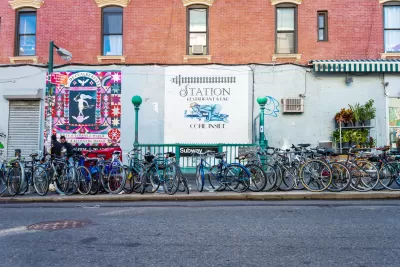
"Driven by demand as well as a city mandate, developers and building owners are carving out bike rooms for residents to store what for some has become their transportation mode of choice," writes Jane Margolies for The New York Times.
The state-of-the-art spaces often have their own entrances, saving wear-and-tear on the lobby and passenger elevators. They also offer their own gear by way of pumps and repair stands, and, sometimes, homey touches like hooks for hanging helmets. In the fancier buildings, porters and door attendants act as bike valets.
Of course, riders can store their bikes in their apartments, if there’s room. But “now when you’re spending a million dollars for a one-bedroom,” said Roberta Axelrod, the director of residential sales and marketing at Time Equities [a real estate agency], “no one wants a bike in there” propped against the wall.
And it's not just new buildings that are seeing the consequences of increased ridership as older buildings are converting underutilized areas into bike rooms. "As for new buildings, a zoning amendment passed in 2009 requires the provision of one bike space for every two units in structures of 10 apartments or more," adds Margolies. However, that's often a bare-bones requirement inadequate for larger units.
If you have a building with two- and three-bedroom apartments, 100 units doesn’t mean 100 bikes,” said Matthew Baron, the president of Simon Baron Development. “It could be 300 or 400.” Consequently, there are waiting lists for many of the city’s bike rooms.
Would you like a bike with that unit?
"Many buildings are providing the bicycles themselves, acquiring their own fleets — emblazoned with the buildings’ names — for residents’ use," writes Margolies. Other buildings are offering bikes as closing gifts. She goes on to list these apartments, in addition to describing bike storage at new and existing apartments in Brooklyn and Manhattan.
Pay-to-Park
But don't expect to park for free; these spaces often come at a cost. "The charges, which can come in the form of a monthly or annual fee, vary widely, from a token $10 per year to $10 to $100 per month," adds Margolies.
FULL STORY: Buildings Get Bike Friendly

Bike Storage is the New Hot Commodity
With bike riding and commuting soaring in NYC, the question of where to store bikes - at home, is becoming more important. Bike storage is now a hot amenity in many Brooklyn and Manhattan apartments - so much that monthly fees may apply.
NYC needs 700,000 new homes to resolve housing crisis, report states
The report gave every neighborhood a non-binding development target.
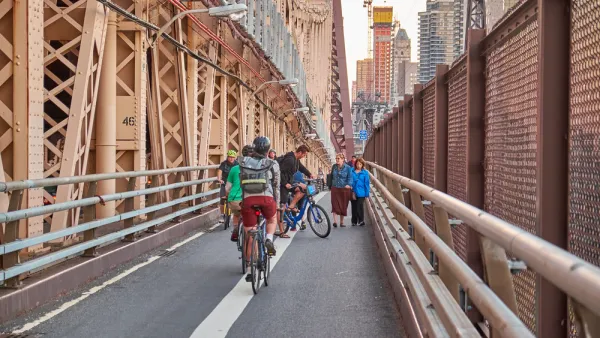
Bike-Centered Brooklyn Bridge Redo Under Consideration
City officials in New York are discussing the possibility of converting a car traffic lane on the Brooklyn Bridge for use by people on bikes.

Planetizen Federal Action Tracker
A weekly monitor of how Trump’s orders and actions are impacting planners and planning in America.

The state-sanctioned urbicide of Austin
People don’t kill cities. Freeways do.

US to reduce Colorado River water deliveries to Mexico
A new Colorado Treaty amendment reduces Mexico’s Colorado River water allocation by 250,000 acre feet.

5 New England states march closer to 800 megawatt wind energy project
Securing federal approval for the project may be complicated under the Trump administration, which has historically been hostile towards domestic wind power.

Baltimore to break ground on $50 million Transit Priority Project
The project will bring faster bus trips, safer streets and better bike connections to Baltimore.

Airbnb launches $250 million 'last-dollar financing' housing accelerator, makes first investment in Austin
The company will put $6.4 million towards affordable housing development in Texas’ capital.

FREE Course: Walkable City 1: Why Walkability?
After describing his path towards focusing on walkability as the essence of good planning, Jeff Speck marches through his five principal reasons for making more walkable places.
Reinventing Malls: Planning Alchemy—Turning Gray Fields Into Gold
The course focuses on the opportunities and imperatives that shape reinvention of mall sites.

Eagle County Government
Harvard University Graduate School of Design
Nashville Planning Department
The Architects Foundation
University of Cincinnati Online
The Pocatello Development Authority
The Urban Renewal Agency of the City of Pocatello
Journal of the American Planning Association