At first glance, a meritocratic vision is morally compelling, but upon closer scrutiny, its pursuit ends up legitimizing—and thus reinforcing—the very social and economic inequality it purports to rectify.


"Together we can break down all the barriers holding our families … back. We can build ladders of opportunity … so every single American can have that chance to live up to his or her God-given potential. Then and only then can America live up to its full potential, too." – Hillary Clinton.
This aspiration forms, in a nutshell, the central vision of Hillary Clinton’s quest for the Democratic presidential nomination. What it boils down to is the desire to create a flourishing meritocracy in America. When we “break down all the barriers” holding people back, “every single American” will have the opportunity “to live up to his or her God-given potential.” Simply put, once individual potentialities have been liberated by the removal of barriers blocking advancement, all persons will have the chance to reach a place in American society determined not by the limited opportunities they face, but rather by what they truly merit.
At first glance, this meritocratic vision is morally compelling: that all, regardless of initial circumstances, should have an opportunity to achieve as much as their talents, skills, ability, intelligence, and efforts warrant. As such, it is broadly embraced in America. It sets the groundwork for our political debates, as political analyst Christopher Hayes has recently pointed out, but is “never itself the subject of them, because the belief [in meritocracy] is so widely shared.”
Upon closer scrutiny, however, the meritocratic ideal turns out to be quite pernicious. Summarizing the conclusion of my recent article on the subject, I find that, while this ideal is highly unlikely to achieve its core objectives (except maybe on the margins), its pursuit nonetheless creates “a competitive individualist ‘rat race’ of a society, fundamentally anti-communal and anti-familial, where group solidarity is uncommon and compassion muted.” And, worst of all, it ends up legitimizing—and thus reinforcing—the very social and economic inequality it purports to rectify.
The real tragedy for scholars and practitioners of community development is that, while we might not initially realize it, many of our urban and social policies, especially those advocated by political liberals, are rooted firmly in this pernicious ideal (or what I call a “Meritocratic Paradigm”). In sync with a quintessentially liberal politician like Clinton, this paradigm first identifies the “barriers holding our families … back” from reaching their “God-given potential.” Then it seeks to “break down” these barriers via various policy interventions (with the ostensible result being a marked increase in the upward social mobility of those demonstrating the requisite “merit”).
Read the full story: Is a Meritocracy Really What We Want?


California State University System Leads Nation in Economic Mobility for Students
A new study ranks California State University campuses among the top institutions in California for economic mobility, demonstrating their success in providing affordable education that significantly boosts students’ long-term earnings.

Low-Income Residents Less Likely to Move During the Pandemic, Freddie Mac Says
Does low-income residents staying put in large metro areas, relative to higher-income groups, mean that low-income households are missing out on affordable housing options? Freddie Mac researchers think so.
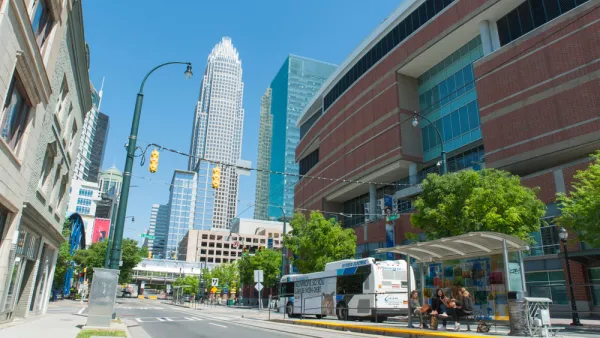
Charlotte Mobility Plan Centers Improved Multimodal Options and Economic Mobility
The city’s newly approved Strategic Mobility Plan highlights the need for better options when it comes to walking, biking, and public transit, setting a goal to reduce driving to half of total trips.

Planetizen Federal Action Tracker
A weekly monitor of how Trump’s orders and actions are impacting planners and planning in America.

Amtrak, CN end decades-long dispute with eight-year agreement
The new operating agreement establishes an updated framework for the companies to work together, including processes to resolve disputes.

Northwest rail fans eager for Sept. 30 debut of Amtrak’s Airo fleet
Get ready for that new train smell and more seats. But they won’t go faster or run more frequently on the Cascades route in Washington and Oregon.

St. Louis Metro to test if single-car trains can reduce operating costs, maintain rider satisfaction
The pilot program will run from October to spring 2027, and begin with one single-car train operating on Metrolink’s Red and Blue lines.

Pennsylvania is building data centers in abandoned mines
Housing data centers in mines provides an alternative to destroying local forests and may spare residents from data centers’ noise and air pollution.

If Corpus Christi can’t revive desalination plant project, it may owe Texas $235 million
Earlier this month, city officials declined to pursue developing the plant for the second time in a year.

FREE Course: Walkable City 1: Why Walkability?
After describing his path towards focusing on walkability as the essence of good planning, Jeff Speck marches through his five principal reasons for making more walkable places.
Reinventing Malls: Planning Alchemy—Turning Gray Fields Into Gold
The course focuses on the opportunities and imperatives that shape reinvention of mall sites.

City of Thousand Oaks
City of Wisconsin Rapids
Harvard University Graduate School of Design
The Architects Foundation
University of Cincinnati Online
The Pocatello Development Authority
The Urban Renewal Agency of the City of Pocatello