Pasadena should adopt measures that couple homeless services with controls on aggressive panhandling and camping in certain areas of the city, urges Jonathan P. Bell, urban planner and Pasadena resident.


With homelessness growing worse, and both the city and county of Los Angeles recently adopting comprehensive plans to address homelessness, it's time for Pasadena to do the same, urges Jonathan P. Bell, an urban planner and Pasadena resident. Such a plan was brought before Pasadena's Public Safety Committee on March 23, 2016. It included a number topics listed below in abbreviated fashion:
1) Enact local ordinances to bolster responsive law enforcement
- New ordinance defining “camping,” “maintaining a camping facility,” and “lodging”
- New ordinance delineating the spatial boundaries of business districts
- New ordinance prohibiting begging or soliciting in any public right-of way using “threatening, coercive, or menacing” behavior
2) Create and expand housing programs
- Landlord Reimbursement Fund
- Homeless Prevention Fund
- Motel to Housing Voucher Engagement Program
- Rapid Re-housing Program
3) Consider additional municipal responses and social welfare programs
- Public Libraries Homeless Caseworker
- Additional Homeless Outreach-Psychiatric Evaluation (HOPE) Team
- Enhanced Security at City Parks
- Code of Conduct Policies
- Expedited Demolition of Vacant Buildings
4) Adopt a permanent supportive housing policy statement
The op-ed provides a more a detailed explanation of these measures. In an unusual move, on March 23, 2016, the city's Public Safety Committee moved the staff recommendation to adopt a homeless measures ordinance to the full City Council without a committee recommendation. Council will likely consider the measures ordinance at its April 11, 2016 meeting.
Read the full story: Urge Pasadena to Approve the Measures to Address Homelessness

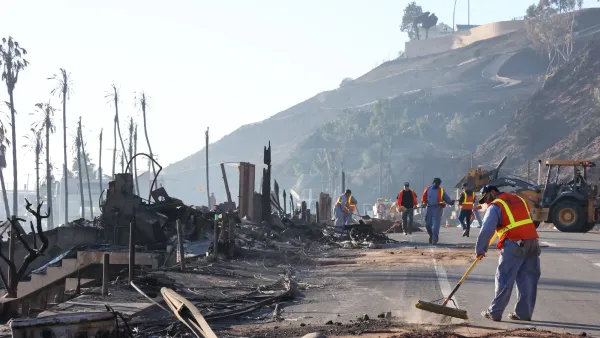
Malibu and Pasadena residents will be able to build up to 4 units on fire-damaged properties
The two cities settled a lawsuit brought by a YIMBY group that challenged their ban on multifamily housing in fire-impacted areas.
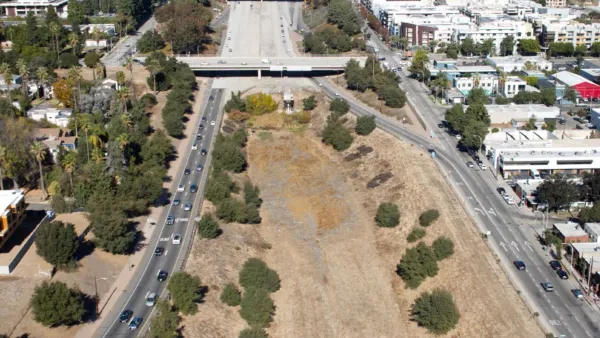
Pasadena approves plan for 710 Stub but tables Restorative Justice elements
A never-built freeway that displaced hundreds of residents in the 1970s has left a 50-acre scar that may finally see redevelopment.

California TOD Law Gives NIMBYs a new Weapon Against Bus Lanes
A new law that allows rezoning for higher density near transit lines is fueling opposition to a Burbank bus rapid transit line.

Amtrak, CN end decades-long dispute with eight-year agreement
The new operating agreement establishes an updated framework for the companies to work together, including processes to resolve disputes.

Judges permit Denver to divert 77,000 acre feet from the Colorado River for reservoir expansion
Overuse and climate change have caused the Colorado River’s water levels to plummet.

Nation's most wind-powered state turns to coal as data centers increase energy demand
For the first time in decades, Iowa has increased its generation of coal power.

Boston has spent millions making the Green Line more accessible — and there’s no end in sight
While the city has invested millions into expanding and adding platforms to the Green Line to make it more accessible, new train cars set to arrive next year will be too tall for disabled passengers to board without raising the current platforms.

Idaho may see an 18% drop in federal surface transit funding — the largest estimated cut in the US
Transit systems in rural communities are much more reliant on federal funding to provide their services.

How ‘post-disaster gentrification’ alters neighborhoods after natural calamities
After hurricanes, fires or other calamities, the original residents of a community are often replaced by younger, wealthier residents.

FREE Course: Walkable City 1: Why Walkability?
After describing his path towards focusing on walkability as the essence of good planning, Jeff Speck marches through his five principal reasons for making more walkable places.
Reinventing Malls: Planning Alchemy—Turning Gray Fields Into Gold
The course focuses on the opportunities and imperatives that shape reinvention of mall sites.

City of Wisconsin Rapids
Harvard University Graduate School of Design
KFH Group Inc.
The Architects Foundation
University of Cincinnati Online
The Pocatello Development Authority
The Urban Renewal Agency of the City of Pocatello