An opinion piece says its time for transit agencies to start treating riders like valued customers.


Jim Stone examines one of the eternal (until someone fixes it) problem of public transit: how to keep "choice riders" on public transit. A voluntary rider of public transit himself, Stone has a confession to make: "As much as I prefer using public transportation, it’s getting more difficult for me to like it. The reason boils down to two words: customer service."
After recounting a particularly unfortunate example of poor customer service, Stone sets about prescribing four actions for transit agencies such as his own in San Diego to undertake:
- Make customer service the priority, not fare recovery.
- Keep customers (i.e., riders) informed of delays.
- Keep trolleys and buses as clean as possible.
- Improve payment systems.
Stone, like many of us, is rooting for transit to improve in popularity. Stone doesn't see that happening unless transit agencies "create the best possible experience for passengers riding the trolley or a bus…"
Read the full story: Want to Improve Public Transit? Prioritize Service Over Fare Enforcement

Milwaukee transit agency plans 25% service cuts
The MCTS system will have to make a difficult choice between service frequency and coverage.
Fisticuffs: The argument AGAINST fare-free transit
If a terrible bus becomes free, will it truly free you?
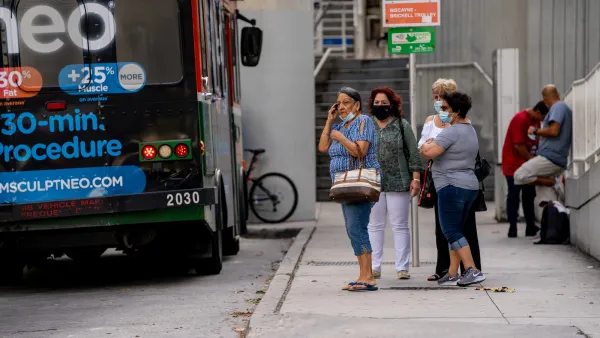
Miami promised a 'Better Bus Network.' Riders say it hasn't delivered.
Ridership on Miami-Dade Transit dropped by 2%-10% every month between October and December 2025.

Planetizen Federal Action Tracker
A weekly monitor of how Trump’s orders and actions are impacting planners and planning in America.

California plans to bury El Niño’s downpour
If the state plays its cards right, it may be able to store a billion acre-feet of El Niño’s water in aquifers.

Desperate measures: Advocates weigh draining Lake Powell to fill Colorado River
Draining the reservoir could reduce evaporation losses by a couple hundred thousand acre-feet.

Mamdani’s pied-à-terre tax survives legal challenge
A panel of judges found that the plaintiffs failed to demonstrate injury as a result of New York City's implementation of the tax.

Eastern Nebraska is running out of electricity
Data centers and electrification are straining eastern Nebraska’s grid, throttling economic development.

Seattle passes record-breaking transit services expansion
Proposition 1 will double the city’s transit tax to add 95,000 more bus trips and preserve 180,000 bus trips annually.

FREE Course: Walkable City 1: Why Walkability?
After describing his path towards focusing on walkability as the essence of good planning, Jeff Speck marches through his five principal reasons for making more walkable places.
Reinventing Malls: Planning Alchemy—Turning Gray Fields Into Gold
The course focuses on the opportunities and imperatives that shape reinvention of mall sites.

City of Rosemead
Rutgers University, Edward J. Bloustein School of Planning and Public Policy
One Hundred Miles
University of Michigan School for Environment and Sustainability (SEAS)
Hunter College, City University of New York (CUNY)
The Architects Foundation
City of Cambridge
Montrose County
The Pocatello Development Authority