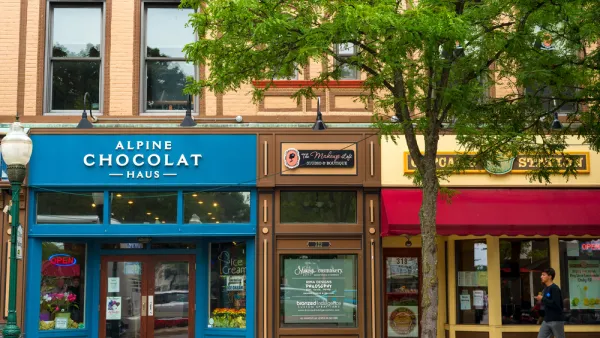
Need some pointers on how to make downtown retail sing? Check out Hazel Borys' crib notes on Bob Gibbs' directions.


"There are all sorts of reasons for the current retail imbalance that has created dark and under-performing storefronts in the heart of second tier cities, and some of it has to do with perception. Retailers are biased against locating in poor areas, even though the spending power per acre of poor neighborhoods is usually significantly greater than the suburbs because of greater density. Adding to perception problems is the very real problem of land use, which often favors the suburbs. We’ve blogged extensively about how to level the playing field as well as pointing to the places that are upgrading zoning practices." "Trying to build a downtown out of just specialty shops also doesn’t work because form follows anchor. You can only support about 30,000 square feet of retail without an anchor. And that doesn’t necessarily mean a baby box retailer anchoring main street – non-retail amenities like a library, post office, and courthouse are all strong civic anchors." Borys goes on to share Gibbs pointers on market preference, anchors, the mix, walkability, and retail merchandising essentials. 
Read the full story: Retail: Walkable urban primer with southwest inspiration

Rules for Planning Successful Retail Developments
Hazel Borys discusses how several key form-based guidelines for retail can encourage success in the most risky of all development types.
Main Street Revitalization Efforts Turn a Corner
Having lured its first major retailer on Main Street, revitalization efforts in Columbia, South Carolina's urban corridor seem to be finally paying off.
Keeping Downtown Main Streets Full
Oakland County, Michigan has announced an initiative to attract and retain retail businesses.

Planetizen Federal Action Tracker
A weekly monitor of how Trump’s orders and actions are impacting planners and planning in America.

Northwest rail fans eager for Sept. 30 debut of Amtrak’s Airo fleet
Get ready for that new train smell and more seats. But they won’t go faster or run more frequently on the Cascades route in Washington and Oregon.

Record-breaking wildlife overpass in Colorado brings 91% reduction in animal collisions
Prior to the overpass, vehicles were hitting one deer per day on Colorado’s Interstate 25.

Detroit to transform waterfront with $2.2 billion investment
Developers will convert about 18 acres of unused parking lot space into civic spaces.

‘Going backwards:’ Baltimore mayor, students rally against state's transit funding plan
Maryland's proposed six-year plan provides no funding for Baltimore’s BMORE bus program and reduces its road maintenance funding.

Trump wants to cancel nearly 98% of funding for HUD housing support program
Multiple housing groups are suing the administration in an effort to preserve the funding.

FREE Course: Walkable City 1: Why Walkability?
After describing his path towards focusing on walkability as the essence of good planning, Jeff Speck marches through his five principal reasons for making more walkable places.
Reinventing Malls: Planning Alchemy—Turning Gray Fields Into Gold
The course focuses on the opportunities and imperatives that shape reinvention of mall sites.

City of Thousand Oaks
City of Wisconsin Rapids
Harvard University Graduate School of Design
The Architects Foundation
University of Cincinnati Online
Northern Illinois Transit Authority (NITA)
The Pocatello Development Authority
The Urban Renewal Agency of the City of Pocatello