In a rebuttal to criticisms leveled at historic preservation districts, Stephanie Meeks of the National Trust for Historic Preservation argues that historic preservation has value and can aid in creating affordable housing.


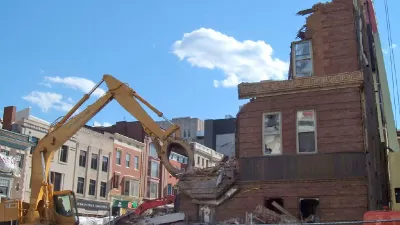
Writing in CityLab, Stephanie Meeks asks that critics who claim that historic preservation districts are contributing to a lack of affordable housing in our cities take a step back and find "ways to increase density and affordability in cities that don’t involve destroying the historic fabric of our communities."
Meeks writes that the benefits from our historic neighborhoods are both tangible and intangible. They connect residents to their neighborhoods and to those who came before, creating what Meeks describes as "living history lessons." In addition, many of our older neighborhoods hold opportunities for the adaptive reuse of the existing building stock to create multi-family units. Creating density in older neighborhoods doesn’t always require tearing down existing buildings to build taller.
Economists such as Edward Glaeser have argued that historic districts prevent affordability by limiting tall and dense new development that could fit everyone. But, as the urban planner Jeff Speck points out in Walkable City, 'economists don’t seem to have fully processed one thing the designers know, which is how tremendously dense a city can become at moderate heights.'
FULL STORY: Why Historic Preservation Districts Are Crucial to Cities


Historic Newark building to become affordable housing
The century-old building will be converted into nearly 200 homes with ground-floor retail.

The Trouble With QUIMBY
The idea of “quality urbanism in my back yard” has its uses, but should not be used to limit housing supply.

California Bill Seeks to Balance Preservation and Housing Demand
A bill awaiting the governor’s signature would require cities to report new historic preservation ordinances and assess how they impact local housing supplies.

Planetizen Federal Action Tracker
A weekly monitor of how Trump’s orders and actions are impacting planners and planning in America.

The state-sanctioned urbicide of Austin
People don’t kill cities. Freeways do.

US to reduce Colorado River water deliveries to Mexico
A new Colorado Treaty amendment reduces Mexico’s Colorado River water allocation by 250,000 acre feet.

5 New England states march closer to 800 megawatt wind energy project
Securing federal approval for the project may be complicated under the Trump administration, which has historically been hostile towards domestic wind power.

Baltimore to break ground on $50 million Transit Priority Project
The project will bring faster bus trips, safer streets and better bike connections to Baltimore.

Airbnb launches $250 million 'last-dollar financing' housing accelerator, makes first investment in Austin
The company will put $6.4 million towards affordable housing development in Texas’ capital.

FREE Course: Walkable City 1: Why Walkability?
After describing his path towards focusing on walkability as the essence of good planning, Jeff Speck marches through his five principal reasons for making more walkable places.
Reinventing Malls: Planning Alchemy—Turning Gray Fields Into Gold
The course focuses on the opportunities and imperatives that shape reinvention of mall sites.

Eagle County Government
Harvard University Graduate School of Design
Nashville Planning Department
The Architects Foundation
University of Cincinnati Online
The Pocatello Development Authority
The Urban Renewal Agency of the City of Pocatello
Journal of the American Planning Association