It's not just millennials anymore. A new study finds more people are going without driver's licenses than in previous decades.


"The trend [of driving less and getting rid of cars] is gaining traction in middle-aged adults, to the point where fewer of them are even bothering to get or renew their driver's licenses, but it's been prominent among younger adults — millennials — for years now," reports David Schaper.
Schaper cites a new study published [pdf] by University of Michigan's Transportation Research as evidence of these claims, and speaks with the study's lead author, Brandon Schoettle.
According to the study, only 69 percent of 19-year-olds have a driver's license in 2014, compared with almost 90 percent in 1983. The percentage of 20-somethings with driver's licenses has also fallen by 13 percent over the past three decades, and fewer Americans in their 30s and 40s now have driver's licenses.
The article includes an infographic that illustrates how much less common driver's licenses are among age groups broken down into five-year groupings. The exception to the decrease is found at the top end of the spectrum, with drivers 60 years old and beyond. The study's findings, of course, don't mean Americans are driving less—just that a larger proportion of Americans are opting not to drive. In November 2015, the Federal Highway Administration reported a new record in Vehicle Miles Traveled.
Read the full story: Like Millennials, More Older Americans Steering Away From Driving

'Little Evidence of a Substantial Cultural Turn' Away from Driving Among Millennials
According to an analysis of U.S. National Travel Surveys, the Millennial preference for non-automotive travel is mostly hype. Millennials show behavior similar to other age groups and respond to the economy.
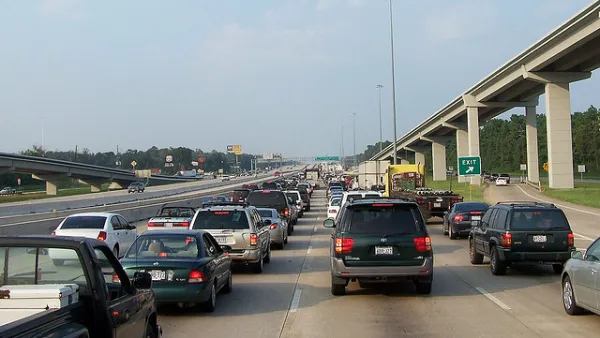
Trends Show Lower-Income Millennials Driving More
Data from the 2017 National Household Travel Survey reveals that circumstances may be forcing lower-income young people to drive greater distances.
Blaming Millennials for Decaying Road Infrastructure
If you thought inflation and fuel efficiency, along with politicians unwillingness to raise gas taxes were the main causes of America's decaying road and bridges, S&P adds another contributing factor—millennial transportation preferences.

Washington state to charge fee to drivers with fuel-efficient cars
Revenue from the fee will go towards supporting the state’s highways.

Illinois considers spending $1 billion in taxpayer money on data center
A quantum computing campus and data center are currently under construction in Chicago.

Trump to blast ‘hydrocarbon highway’ through ‘world’s longest art gallery’
Environmental and historic preservation groups are suing to stop the project.

NYC, state sue feds over mixed-immigration-status housing assistance rule
The state’s lawsuit argues that the rule change violates the Administrative Procedure Act.

Michigan to turn neighborhood into virtual power plant
Residents will soon be able to divert their excess energy to the grid in exchange for compensation.

Data center, mining project swarm to long-awaited Alaska railroad line
The state-owned railroad approved final plans for the spur line this week; the project is expected to cost $311 million, mostly funded by the federal government

FREE Course: Walkable City 1: Why Walkability?
After describing his path towards focusing on walkability as the essence of good planning, Jeff Speck marches through his five principal reasons for making more walkable places.
Reinventing Malls: Planning Alchemy—Turning Gray Fields Into Gold
The course focuses on the opportunities and imperatives that shape reinvention of mall sites.

City of Charlotte
City of Rosemead
Rutgers University, Edward J. Bloustein School of Planning and Public Policy
University of Michigan School for Environment and Sustainability (SEAS)
Hunter College, City University of New York (CUNY)
The Architects Foundation
University District Partnership