The Atlanta Studies website takes a deep dive into the history that produced the city of Atlanta as we know it today—and provides some suggestions on how to "correct some of its most atrocious attacks on the urban built environment."


Joseph Hurley, from Georgia State University, has penned a long essay titled "Atlanta's War on Density," that endeavors to "explain how Atlanta’s war on density was propagated, explore what Atlanta has lost in terms of the residential built environment, and will end by challenging Atlanta’s leaders and developers to fully abandon the war on density in favor of people-focused, urban residential development in the Turner Field and Civic Center areas."
Though Hurley takes those two pending redevelopment projects as inspiration for the article, which includes lots of historic photos and references to historic planning documents, it's also worth noting that Atlanta is underway with a process to update its zoning code, with similarly stated goals as those pursued by Hurley.
Read the full story: Atlanta's War on Density
Tracking the Rate of Sprawl for U.S. Cities between 2000 and 2010
Many studies have measured and compared the sprawl of U.S. metropolitan areas. A recent study tracks the rate at which the same cities grew either less compact or more compact for the decade between 2000 and 2010.
The End of Atlanta's Sprawl
The age of sprawl is ending in Atlanta, according to Christopher Leinberger, who highlights the city's move towards a more dense, walkable future.
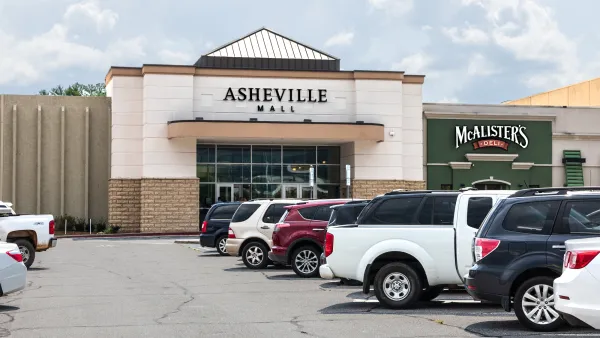
Asheville reconsiders parking minimums as surface parking eats up over a third of downtown real estate
Housing advocates say parking requirements are unnecessary and induce sprawl.

Planetizen Federal Action Tracker
A weekly monitor of how Trump’s orders and actions are impacting planners and planning in America.

California plans to bury El Niño’s downpour
If the state plays its cards right, it may be able to store a billion acre-feet of El Niño’s water in aquifers.

Desperate measures: Advocates weigh draining Lake Powell to fill Colorado River
Draining the reservoir could reduce evaporation losses by a couple hundred thousand acre-feet.

Seattle passes record-breaking transit services expansion
Proposition 1 will double the city’s transit tax to add 95,000 more bus trips and preserve 180,000 bus trips annually.

Post election, Texas is no longer Musk’s 'AI oasis'
Elon Musk dolled out $446 million on the 2026 midterms, the most ever spent by a non-canidate.

Chicago voters approve permanent festival grounds, penalty for vacant property owners
Currently, major summer and fall festivals take over public parks for weeks at a time, drawing criticism from nearby residents

FREE Course: Walkable City 1: Why Walkability?
After describing his path towards focusing on walkability as the essence of good planning, Jeff Speck marches through his five principal reasons for making more walkable places.
Reinventing Malls: Planning Alchemy—Turning Gray Fields Into Gold
The course focuses on the opportunities and imperatives that shape reinvention of mall sites.

City of Rosemead
Rutgers University, Edward J. Bloustein School of Planning and Public Policy
One Hundred Miles
Hunter College, City University of New York (CUNY)
The Architects Foundation
University of Cincinnati Online
City of Cambridge
Montrose County
The Pocatello Development Authority