The contest on the gridiron might be of secondary consideration if the NFL and regional transportation planners can't manage the traffic to and from the game on Sunday.


Michael Cabanatuan reports on the efforts of local officials, and NFL officials, to plan for the hordes of fans that will descend on Santa Clara for Super Bowl 50 this Sunday.
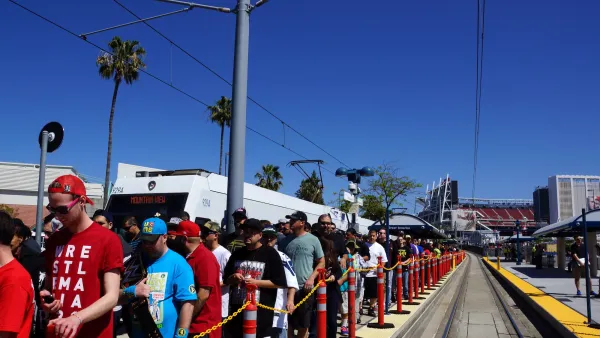
The NFL’s strategy for Super Bowl Sunday counts on adding hundreds of private charter buses, limiting the number of people allowed to ride light rail to the stadium, dedicating zones for taxis and Uber, and keeping looky-loos without tickets from hanging around the event.
Executing the plan will be a challenge. The suburban location of Levi’s Stadium, the lack of direct freeway access, the dispersed parking lots and a limited transit system have made getting fans in and out swiftly as tough as fourth-and-long for the 49ers.
Since Levi's Stadium opened two years ago, it's built a reputation for creating a traffic quagmire on any given Sunday—much less Super Sunday. The process of improving travel to and from the stadium is still very much a work in progress, according to Cabanatuan. Enter the Super Bowl.
Adding to the pressure are the painful lessons from a similarly suburban Super Bowl outside one of the country's most dense cities. Just two years ago, with the Super Bowl hosted in East Rutherford, New Jersey, the so-called "Mass Transit Super Bowl" fell well below expectations for transit users.
FULL STORY: Super Bowl planners try to avoid game-changing traffic mess

Super Bowl and Seahawks Victory Parade Break Transit Ridership Records in Bay Area and Seattle
Roughly 20 percent of Super Bowl attendees arrived at the stadium by transit.
Uber Drivers to Protest on Super Sunday
It's easy to see why Uber would look on a Super Bowl hosted near its Bay Area home would look on the event as a large PR opportunity. Disgruntled Uber drivers see it the same way.

ADUs account for nearly 28% of Bay Area housing permits
In Hillsborough, 56 of 58 homes permitted in 2025 were ADUs.

Planetizen Federal Action Tracker
A weekly monitor of how Trump’s orders and actions are impacting planners and planning in America.

The state-sanctioned urbicide of Austin
People don’t kill cities. Freeways do.

US to reduce Colorado River water deliveries to Mexico
A new Colorado Treaty amendment reduces Mexico’s Colorado River water allocation by 250,000 acre feet.

Mamdani overhauls NYC's Vision Zero plan with 100 new policy goals
The overhaul aims to reduce traffic deaths and make streets safer for pedestrians, cyclists and drivers through lower speed limits, new safety infrastructure and more.

Amtrak not solely to blame for New Jersey commuter rail's unreliability, report finds
A new study from the Garden State Initiative found that NJ Transit’s budget grew 20% across a 4 year period, but reliability declined significantly over the same period.

EPA erases limits on planet-warming pollution from power plants
Under Monday’s plan, power plants would still have some limits on how much mercury, arsenic and other contaminants they can emit.

FREE Course: Walkable City 1: Why Walkability?
After describing his path towards focusing on walkability as the essence of good planning, Jeff Speck marches through his five principal reasons for making more walkable places.
Reinventing Malls: Planning Alchemy—Turning Gray Fields Into Gold
The course focuses on the opportunities and imperatives that shape reinvention of mall sites.

Eagle County Government
Harvard University Graduate School of Design
Nashville Planning Department
The Architects Foundation
University of Cincinnati Online
The Pocatello Development Authority
The Urban Renewal Agency of the City of Pocatello
Journal of the American Planning Association