Following-up on the president's assertion in his State of the Union address to better manage coal and oil resources on federal lands to account for environmental and financial costs, the administration declared a 'pause' on issuing new coal leases.


"I'm going to push to change the way we manage our oil and coal resources so that they better reflect the cost they impose on taxpayers and our planet," stated President Obama last Tuesday in his address to the nation
Readers may recall that a "moratorium" differs from an outright ban in the sense that it applies to a specific period of time. While many in the media used the term moratorium (which it is, in effect), Sally Jewell, Secretary of the Department of Interior uses the term "pause" seven times while omitting "moratorium." The 'pause' takes effect immediately in order to conduct a review of the financial and social costs associated with coal mining on federal lands as noted in her press release:
The programmatic review will examine concerns about the federal coal program that have been raised by the Government Accountability Office, the Interior Department’s Inspector General, Members of Congress and the public. The review, in the form of a Programmatic Environmental Impact Statement (PEIS), will take a careful look at issues such as how, when, and where to lease; how to account for the environmental and public health impacts of federal coal production; and how to ensure American taxpayers are earning a fair return for the use of their public resources.
"The department will consider raising the royalty rates it charges mining companies, which critics have long criticized as too low and rife with loopholes," writes Alan Neuhauser, energy, environment and STEM reporter for U.S. News & World Report. "The review, first reported Thursday evening, will take at least three years."
"Coal companies should be charged as much as five times what it costs them for surface mining on federal lands, according to a new report from a nonpartisan think tank at the New York University School of Law," wrote Neuhauser last October.
In addition to recouping financial costs, the department wants to ensure that the coal leasing costs "take into account [...] what's often called the "social costs" of coal — its impact on climate change and public health," writes Bill Chappell for NPR's "The Two Way."
Finally, NPR's "Weekend Edition Saturday" looked at the impact the pause will have on states, Wyoming in particularly as it is farway the nation's largest coal producer. "In practice, the moratorium won't have much of an immediate effect here," states Wyoming Public Radio's Stephanie Joyce.
Readers may wish to listen to the audio broadcast to appreciate the full reaction of locals to the moratorium in the Cowboy State.
It doesn't stop existing coal production. And the federal government estimates that, nationwide, the leases companies already have could supply 20 years of U.S. demand. But the review is likely to bring about changes that will make it more expensive to mine coal on federal land, and that could have a big impact on Wyoming. Coal provides a quarter of state revenues.
"In Wyoming, most of the federally-owned coal mines and revenue from coal leases pays for school construction," adds Joyce.
The moratorium is somewhat similar to broader legislation proposed last year that calls for an outright ban on new drilling for all fossil fuels, including oil and natural gas, on federal lands and waters.
"If Obama is true to his pledge in the State of the Union, expect to see changes coming in the near future to federal leasing of oil, too," adds Joyce at the end of the NPR broadcast.
Hat tip to David McCoard , Sierra Club Energy listserv.
FULL STORY: Obama Administration Hits Pause on New Coal Leases

A Win for ‘Keep it in the Ground’
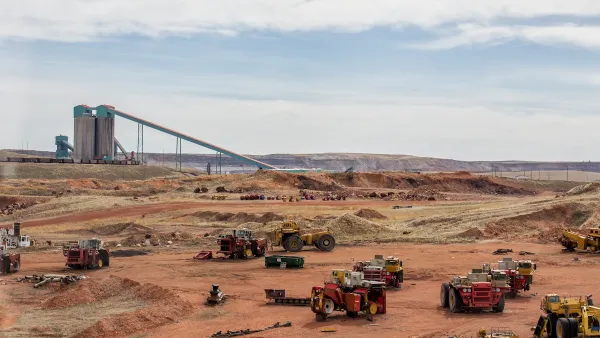
Coal mining in Wyoming will take a major hit as a result of a U.S. Department of Interior plan to cease future leasing of coal mines in the nation's most productive coal mining basin. The decision casts a spotlight on the presidential election.
Judge Halts Sales of New Coal Mining Leases on Federal Lands
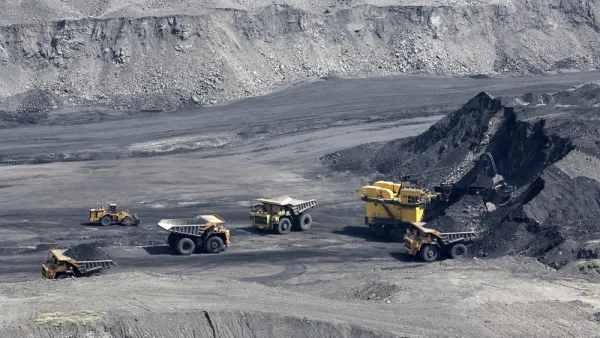
Once again, the president's efforts to undo his predecessor's environmental legacy were thwarted by a court ruling. In this case, the Interior Department's failure to conduct an environmental review of a Trump executive order ran afoul of NEPA.
Coal Miners Are Going Back to Work, Proclaims Trump Upon Signing Executive Order
Flanked by coal miners, President Trump signed an executive order on Tuesday that begins the roll back of his predecessor's signature environmental rule, the Clean Power Plan, and other environmental regulations to facilitate energy production.

Planetizen Federal Action Tracker
A weekly monitor of how Trump’s orders and actions are impacting planners and planning in America.

The state-sanctioned urbicide of Austin
People don’t kill cities. Freeways do.

US to reduce Colorado River water deliveries to Mexico
A new Colorado Treaty amendment reduces Mexico’s Colorado River water allocation by 250,000 acre feet.

5 New England states march closer to 800 megawatt wind energy project
Securing federal approval for the project may be complicated under the Trump administration, which has historically been hostile towards domestic wind power.

Baltimore to break ground on $50 million Transit Priority Project
The project will bring faster bus trips, safer streets and better bike connections to Baltimore.

Airbnb launches $250 million 'last-dollar financing' housing accelerator, makes first investment in Austin
The company will put $6.4 million towards affordable housing development in Texas’ capital.

FREE Course: Walkable City 1: Why Walkability?
After describing his path towards focusing on walkability as the essence of good planning, Jeff Speck marches through his five principal reasons for making more walkable places.
Reinventing Malls: Planning Alchemy—Turning Gray Fields Into Gold
The course focuses on the opportunities and imperatives that shape reinvention of mall sites.

Eagle County Government
Harvard University Graduate School of Design
Nashville Planning Department
The Architects Foundation
University of Cincinnati Online
The Pocatello Development Authority
The Urban Renewal Agency of the City of Pocatello
Journal of the American Planning Association