Some residents of Tuscaloosa, Alabama believe the University of Alabama football team's success on the field has directly contributed to the region's growth.


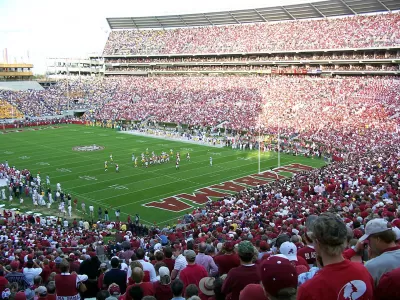
Congratulations Alabama on winning another national championship. If past wins are any indication, the Tide's win will further propel the growth of Tuscaloosa—the home of the University of Alabama. Scott Beyer reports in Forbes that the growth of Tuscaloosa has closely mirrored the success of the football team, with both taking off around the same time Coach Nick Saban arrived in 2007.
This period has inspired a wave of alumni donations and apparel sales, and motivated season ticket holders from out of town to buy second properties there. Tuscaloosa’s population has grown 23.4% since 2000, compared to 15.7% nationally and 9.3% in Alabama. Tuscaloosa was anticipated last year to be the state’s fastest-growing metro area. From 2010-2014, it trailed only the city of Auburn—which also happens to have a successful college football team.
FULL STORY: Are Winning College Football Teams A Catalyst For Urban Growth?

Santa Clara Residents Back Stadium Spending
Residents in Santa Clara, California have approved a measure that would direct $937 million in funding towards the creation of a stadium intended to lure the San Francisco 49ers football team.
The Citywide Impact of New Orleans' Trip to the Super Bowl
New Orleans has had a rough couple of years. But now that the city's professional football team is headed to the Super Bowl, the city is relishing the opportunity to celebrate.

Dallas area transit prepares for World Cup, asks locals to drive
DART is adding a special shuttle service and creating back-up mechanisms to ensure it can serve all of this summer's World Cup attendees.

Planetizen Federal Action Tracker
A weekly monitor of how Trump’s orders and actions are impacting planners and planning in America.

The state-sanctioned urbicide of Austin
People don’t kill cities. Freeways do.

US to reduce Colorado River water deliveries to Mexico
A new Colorado Treaty amendment reduces Mexico’s Colorado River water allocation by 250,000 acre feet.

5 New England states march closer to 800 megawatt wind energy project
Securing federal approval for the project may be complicated under the Trump administration, which has historically been hostile towards domestic wind power.

Baltimore to break ground on $50 million Transit Priority Project
The project will bring faster bus trips, safer streets and better bike connections to Baltimore.

Airbnb launches $250 million 'last-dollar financing' housing accelerator, makes first investment in Austin
The company will put $6.4 million towards affordable housing development in Texas’ capital.

FREE Course: Walkable City 1: Why Walkability?
After describing his path towards focusing on walkability as the essence of good planning, Jeff Speck marches through his five principal reasons for making more walkable places.
Reinventing Malls: Planning Alchemy—Turning Gray Fields Into Gold
The course focuses on the opportunities and imperatives that shape reinvention of mall sites.

Eagle County Government
Harvard University Graduate School of Design
Nashville Planning Department
The Architects Foundation
University of Cincinnati Online
The Pocatello Development Authority
The Urban Renewal Agency of the City of Pocatello
Journal of the American Planning Association