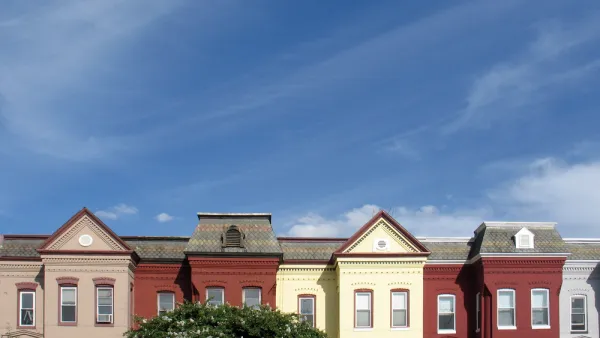
Washington, D.C. is awash in a layer of gray paint that has followed a wave of renovations that have followed the rising cost of housing. Washington City Paper peals away the paint to explore the origins and implications of the fad.


Amanda Kolson Hurley asks the big question of Washington, D.C. real estate: "What’s with all the gray houses?"
The context for the question:
"From Petworth to Anacostia, Riggs Park to Bloomingdale, developers are applying fresh paint in tones of Raincloud or Flagstone to the fronts of newly renovated rowhouses, as subtle as a 25-foot “For Sale” sign. The gray rowhouse shines out to homebuyers not so much as a beacon in the fog but a foggy beacon, its message contradictory: Here is a chance to buy property in D.C., but hurry, it’s fleeting; this neighborhood is desirable but in transition; the house is seemingly pristine, and most likely a flip."
The origins of the color's popularity are unclear, though the financial reasons for renovators to paint over—rather than power wash—century-old brick facades is. Kolson Hurley does speak with an interior designer who makes a case for gray as walking the line between "tradition and classic."
The article includes more on the cultural implications of the growing swath of gray paint covering the Nation's Capital.
FULL STORY: Grayed Expectations: What’s With All the Gray Houses?

Washington D.C. Downzones to Curb Pop-Ups in Rowhouse Neighborhoods
Owners of rowhouse properties in Washington D.C. will no longer be able to add height and density by building pop-ups. The construction provoked the ire of aesthetically minded critics and, now, the regulatory controls of the District's zoning code.
Does Limiting Rowhouse Expansions Preserve, or Prevent, Affordable Housing?
The Washington D.C. Zoning Commission is considering a proposal to limit the ability to convert or expand rowhouses. The proposed ordinance has provoked controversy about the effect of the law for the city's supply of housing.
Proliferation of 'Pop-Ups' Irks Washington D.C. Neighborhoods
Washington D.C. is experiencing a "rush" on new construction of renovated townhouses or "pop-ups," which many say do not fit the character of the neighborhoods where they tend to proliferate.

The state-sanctioned urbicide of Austin
People don’t kill cities. Freeways do.

US to reduce Colorado River water deliveries to Mexico
A new Colorado Treaty amendment reduces Mexico’s Colorado River water allocation by 250,000 acre feet.

New Jersey’s second-largest city bans standalone data centers
Jersey City will continue to allow co-location facilities, such as those meant for research institutions that store their own data.

Amtrak not solely to blame for New Jersey commuter rail's unreliability, report finds
A new study from the Garden State Initiative found that NJ Transit’s budget grew 20% across a 4 year period, but reliability declined significantly over the same period.

EPA erases limits on planet-warming pollution from power plants
Under Monday’s plan, power plants would still have some limits on how much mercury, arsenic and other contaminants they can emit.

Phoenix announces new on-demand transit service, more frequent RAPID buses
Both new services will launch in October, and are part of Phoenix's Project Effective Access Solutions for Easing Congestion.

FREE Course: Walkable City 1: Why Walkability?
After describing his path towards focusing on walkability as the essence of good planning, Jeff Speck marches through his five principal reasons for making more walkable places.
Reinventing Malls: Planning Alchemy—Turning Gray Fields Into Gold
The course focuses on the opportunities and imperatives that shape reinvention of mall sites.

Eagle County Government
Harvard University Graduate School of Design
Nashville Planning Department
The Architects Foundation
University of Cincinnati Online
The Pocatello Development Authority
The Urban Renewal Agency of the City of Pocatello
Journal of the American Planning Association