Jody Avirgan shares insight into a new podcast with the creators of the new Pixar movie The Good Dinosaur, which reads like more of an advertisement for the U.S. Geological Survey (USGS).


A 30-minute "What's the Point" podcast puts host Jody Avirgan in conversation with David Munier, set supervisor for the new Pixar film The Good Dinosaur. A clip introducing the podcast quotes Munier describing the environment as the antagonist in the film, requiring a higher degree of realism than a completely fantasy world often offers. Avirgan describes the role of the USGS in making the landscapes come to life:
"Pixar used actual U.S. Geological Survey information to render the landscapes that Arlo and Spot (the titular dinosaur and his pet human) traipse around in. This data allowed the animators to re-create actual mountains, streams and horizons, which in turn let director Pete Sohn compose the wide-open shots he was looking for."
Part of the podcast's fascination with the film is the amount of data that the film used—one scene, for instance, used as much data as the entirety of the 2011 film Cars 2.
Also included in the podcast is a conversation between Derrick Clements of "The Pixar Podcast" and Mike Tischler, director of the USGS National Geospatial Program, about how the USGS gathers data.
Read the full story: The Dream World Of ‘The Good Dinosaur’ Is Based On USGS Surveys
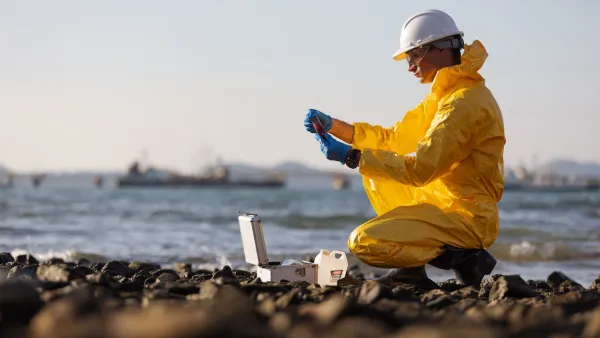
USGS Water Science Centers Targeted for Closure
If their work is suspended, states could lose a valuable resource for monitoring, understanding, and managing water resources.
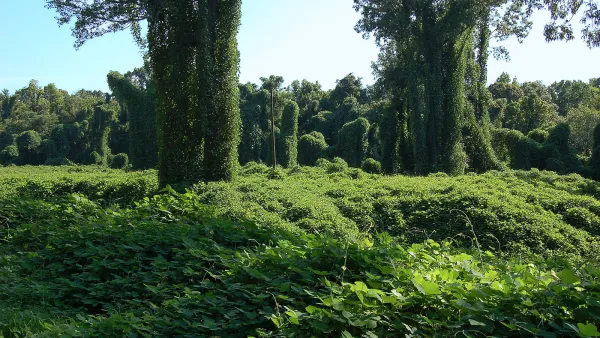
Finding New Uses for the 'Vine That Ate the South'
Visually striking and aggressively invasive, kudzu has been choking the Southeast for decades. Now, designers, chefs, and activists want to find ways to make it useful.

Where the Ground Sinks Under the Weight of Development
New research documents how the weight of buildings causes the ground to sink underneath developments in the San Francisco Bay Area.

Desperate measures: Advocates weigh draining Lake Powell to fill Colorado River
Draining the reservoir could reduce evaporation losses by a couple hundred thousand acre-feet.

Eastern Nebraska is running out of electricity
Data centers and electrification are straining eastern Nebraska’s grid, throttling economic development.

Malls are becoming the midtowns of the future
Mall and office park redevelopments are a generational opportunity to create new nodes of urbanity.

NYC breaks ground on anti-flooding infrastructure project
New York City's new system will reduce stormwater flows to local sewers by 90%.

One Kentucky town’s secret to affordable housing
The Smoketown Community Land Trust has already built seven affordable homes for community members.

Houston gains petal-shaped cooling infrastructure to make streets more ‘delightful’
The city has installed the pavilions along 15 blocks in Houston.

FREE Course: Walkable City 1: Why Walkability?
After describing his path towards focusing on walkability as the essence of good planning, Jeff Speck marches through his five principal reasons for making more walkable places.
Reinventing Malls: Planning Alchemy—Turning Gray Fields Into Gold
The course focuses on the opportunities and imperatives that shape reinvention of mall sites.

City of Rosemead
Rutgers University, Edward J. Bloustein School of Planning and Public Policy
One Hundred Miles
University of Michigan School for Environment and Sustainability (SEAS)
Hunter College, City University of New York (CUNY)
The Architects Foundation
City of Cambridge
Montrose County
The Pocatello Development Authority