Writing in The Guardian's Bike Blog, Peter Walker has an important message for the 40,000 delegates from 195 nations gathered in Paris for the COP21 talks: Don't discount the carbon-reducing, planet-saving potential of the bicycle.


As the delegates at COP21 begin work on a new world climate treaty to keep temperature increase to no more than 2 degrees Celsius, "it’s time to consider what role the humble bike can play in combating global warming," writes Peter Walker in The Guardian's bike blog.
One of the most exhaustive studies was carried out by the European Cycling Federation (ECF) in 2011. [See two earlier Planetizen posts on the study in 'related' below.] This began by trying to compare the average emissions for bikes and e-bikes with other forms of transport, calculating both the environmental cost of manufacture and of use, which for ordinary bikes included extra calories consumed.
The findings showed that "if all the EU’s nations achieved Danish levels of cycling this alone would account for between 5% and 11% of the emissions reductions needed to reach the EU’s official 2020 emissions targets," writes Walker.
A similar study came out last week, from the New York-based Institute for Transportation and Development Policy and the University of California, Davis. This found that even e-bikes can often prove more energy efficient per passenger-kilometre than many rail systems.
It concluded that a not-too-outrageous upshift in global cycling use – from a current 6% or so of all urban passenger miles to 11% in 2030 and 14% in 2050 – would cut overall emissions by 7% (in 2030) and then 11% (in 2050).
Writing for a British paper, Walker takes aim at his Britain's low funding of bicycling investments per compita compared to Dutch cycling investments and to British road investments. But he doesn't stop there.
Walker also takes aim at electric motor vehicles (EVs), particularly timely in light of the December 3 announcement by the California Environmental Protection Agency of a new goal of "13 North American and European governments to make all new passenger vehicles sold in their jurisdictions zero-emission by 2050." The announcement was also published by The International Council on Clean Transportation.
It’s worth noting that even if everyone suddenly switched to electric cars overnight – unlikely, given they currently make up just over 20,000 of the 2.2m UK new car sales a year – the emissions involved in making them, and their extra weight, would still make them greatly less efficient than bikes.
Walker's concludes that "(i)t’s one of the curious paradoxes of bikes in the modern world, that this largely low-tech device that is so beautifully suited as a solution to the very modern problem of global warming" receives such little attention.
Read the full story: How cycling could help the Paris climate talks change the world

Climate Talks Won't Tackle the 'Car Problem'
The COP21 talks in Paris won't take on transportation directly, "the world’s fastest-growing energy-based contributor to greenhouse gases," writes David Jolly for The New York Times. Electric vehicles and fuel efficiency face formidable challenges.
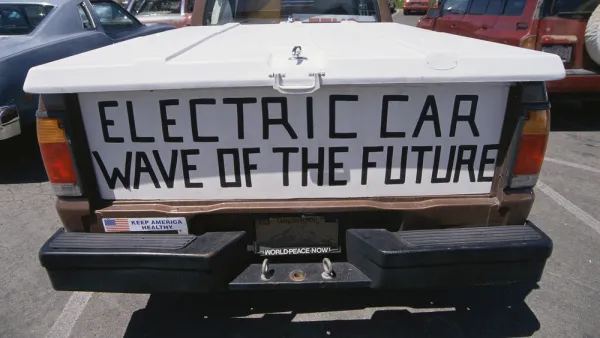
California Lawmaker Wants to Triple Electric Vehicle Rebates
Assemblyman Phil Ting seeks to dramatically increase the state electric vehicle sales rebate of $2,500, motivated in part by the phasing-out of the federal EV tax credit of $7,500. The bill rules out significant revenue sources.
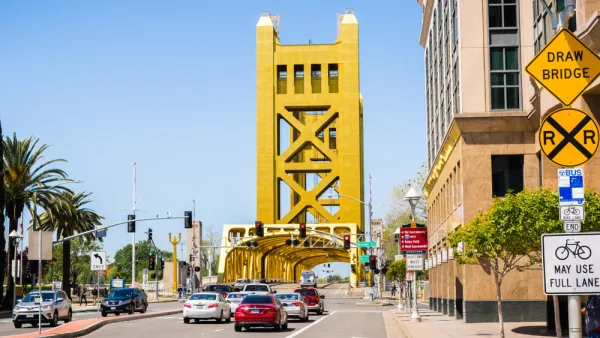
Sacramento Hopes to Lead Transportation Emission Reductions by Example
As California tries to stem its increasing greenhouse gas emissions from the transportation sector, its capital, Sacramento, may prove to be a model for other cities as it embraces electric vehicles and strategies to reduce driving.

Planetizen Federal Action Tracker
A weekly monitor of how Trump’s orders and actions are impacting planners and planning in America.

California plans to bury El Niño’s downpour
If the state plays its cards right, it may be able to store a billion acre-feet of El Niño’s water in aquifers.

Chicago breaks ground on $3 billion megadevelopment
The new neighborhood, titled Foundry Park, will one day host 3,700 residences.

One of Denver’s busiest corridors to gain BRT
The project will span 18 miles and contain 74 bus rapid transit stations.

275,000 bus trips are at stake on Seattle's ballot
If passed, the Seattle Transit Measure would trigger a 0.3% sales tax and raise an average of $138 million per year to maintain and expand Seattle’s bus services.

Texas may pay Israeli company billions to ease water woes
Texas awarded IDE Technologies the contract for its Harbor Island project, which is slated to become the Western Hemisphere's largest desalination plant.

FREE Course: Walkable City 1: Why Walkability?
After describing his path towards focusing on walkability as the essence of good planning, Jeff Speck marches through his five principal reasons for making more walkable places.
Reinventing Malls: Planning Alchemy—Turning Gray Fields Into Gold
The course focuses on the opportunities and imperatives that shape reinvention of mall sites.

City of Rosemead
Rutgers University, Edward J. Bloustein School of Planning and Public Policy
One Hundred Miles
Hunter College, City University of New York (CUNY)
The Architects Foundation
University of Cincinnati Online
City of Cambridge
Montrose County
The Pocatello Development Authority