State rail officials decided that the risk posed by Sonoma Marin Area Rail Transit trains is too grave to allow an existing grade crossing to remain open, forcing pedestrians and a cyclists out of their way to cross the tracks.


In California, the "California Public Utilities Commission (CPUC) staff ensure that highway-rail crossings are safely designed, constructed, and maintained." Some would say they take that commitment to extremes. Case in point: a Santa Rosa pedestrian grade crossing.
On November 4, the CPUC "ordered Santa Rosa and the Sonoma-Marin Area Rail Transit (SMART) agency to take steps to prevent people from crossing the tracks [at Jennings Ave (map)], a popular but unauthorized access route and potentially dangerous point of conflict between trains and schoolchildren," writes Kevin Mccallum of The Press Democrat.
Unlike a September post on a Union Pacific Railroad grade crossing in Houston which indicated that "(t)he solution is to build overpasses or underpasses in as many places as possible," neither is possible at this location according to the Santa Rosa City Council, though the city received a $8.2 million grant for a pedestrian bridge.
Instead, "(t)he city is hoping to convince the state Public Utilities Commission to allow it to build a formal crossing, complete with flashing lights and crossing gates, at that location before rail service begins in late 2016," writes Mccallum.
An artist's rendering depicts a pedestrian and bicycle crossing Santa Rosa plans to pursue at Jennings Avenue.
That request has been met with skepticism by PUC rail safety staff, who argue that it is safer to have fewer at-grade rail crossings because it limits potential collisions between trains and cars, bicycles and pedestrians.
Meanwhile, a 6-foot tall fence is being installed to close the informal crossing from East Jennings Ave. to West Jennings Ave., forcing "residents of the neighborhood east of the tracks, including students at Helen M. Lehman Elementary School, to walk or ride about a quarter-mile north along a dirt access road to Guerneville Road, cross the tracks and walk a quarter-mile back down North Dutton Avenue.," writes Mccallum. See the city's "recommended alternate route for Jennings Avenue east-west connection."
Note the irony - students still cross the tracks at grade—adjacent to heavy vehicular traffic. More irony: a selling point for the 2008 ballot measure authorizing the rail line was the pedestrian-bicycle pathway that would parallel the 70-mile rail line from Cloverdale to San Rafael.
The PUC would allow Jennings Avenue to be properly designed for an at-grade crossing—but only if the city agreed to close another grade crossing. The city argues that because it is limited to pedestrians and cyclists, it should be exempt from that requirement.
Expect a resolution by an administrative judge in the spring. In the meanwhile, residents lose the shortcut which the city argues will do three things, according to Mccallum:
- Put more children in danger along the heavily trafficked Guerneville Road;
- put more cars on the road as parents decide to drive kids to school;
- and prompt people to cut the fence and cross anyway.
Elsewhere on the SMART line, railway officials "approved a $1.4 million contract Wednesday for engineering work on the 2.2-mile segment" to the Larkspur Ferry Landing where passengers would transfer to a ferry to San Francisco, writes Mark Prado for the Marin Independent Journal in an update on the rail line. It is uncertain whether they will receive the $20 million in a federal small starts grant they applied for.
Rail service on Phase One from Sonoma County Airport to San Rafael [map] is expected to begin in late 2016.
Hat tip to Adrian Brandt.
FULL STORY: State PUC orders Santa Rosa, SMART to block risky rail crossings at Jennings Avenue

Bay Area's Newest Commuter Rail Service on Display
The Northwestern Pacific RR served Marin and Sonoma counties and the North Coast in the 1890s. The route of the new SMART train, while not as long, will run in the same right-of-way, starting next year. One new train was on display in San Rafael.

Wine Country Wildfires Put Spotlight on Transmission Lines
No cause has yet been attributed to California's deadliest wildfires, but the connections to fallen power lines and exploding transformers, maintained by PG&E, have been exposed in a series of reports by the Bay Area News Group.
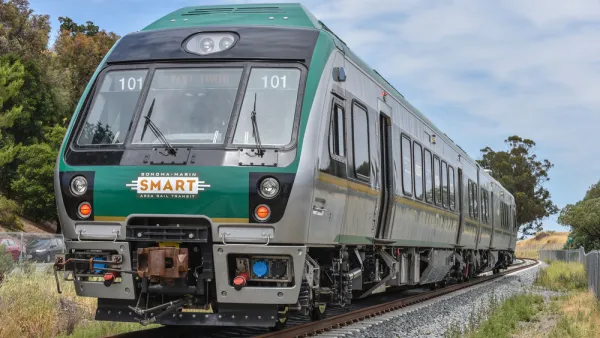
New Commuter Train Comes Through for Fire-Ravaged Santa Rosa
Sonoma-Marin Rail Transit (SMART) has been operating almost continuously at full schedule, collecting no fares since the epic wildfires began in Sonoma County on Oct. 8. Two stations in the fire-zone are shut down due to lack of access.

The state-sanctioned urbicide of Austin
People don’t kill cities. Freeways do.

US to reduce Colorado River water deliveries to Mexico
A new Colorado Treaty amendment reduces Mexico’s Colorado River water allocation by 250,000 acre feet.

New Jersey’s second-largest city bans standalone data centers
Jersey City will continue to allow co-location facilities, such as those meant for research institutions that store their own data.

Amtrak not solely to blame for New Jersey commuter rail's unreliability, report finds
A new study from the Garden State Initiative found that NJ Transit’s budget grew 20% across a 4 year period, but reliability declined significantly over the same period.

EPA erases limits on planet-warming pollution from power plants
Under Monday’s plan, power plants would still have some limits on how much mercury, arsenic and other contaminants they can emit.

Phoenix announces new on-demand transit service, more frequent RAPID buses
Both new services will launch in October, and are part of Phoenix's Project Effective Access Solutions for Easing Congestion.

FREE Course: Walkable City 1: Why Walkability?
After describing his path towards focusing on walkability as the essence of good planning, Jeff Speck marches through his five principal reasons for making more walkable places.
Reinventing Malls: Planning Alchemy—Turning Gray Fields Into Gold
The course focuses on the opportunities and imperatives that shape reinvention of mall sites.

Eagle County Government
Harvard University Graduate School of Design
Nashville Planning Department
The Architects Foundation
University of Cincinnati Online
The Pocatello Development Authority
The Urban Renewal Agency of the City of Pocatello
Journal of the American Planning Association