A new Union of Concerned Scientists report shows that due to considerable gains made in cleaning the electric grid and in producing electric vehicles more efficiently, EVs are the environmentally sensible choice.


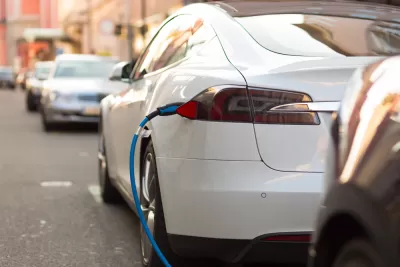
The UCS report, "Cleaner Cars from Cradle to Grave (2015)," considers three variables in its evaluation of lifecycle carbon emissions that includes "vehicle production, operation, and disposal":
- Regional electricity grids across the United States based on the global warming emissions produced from electricity generation,
- Emissions generated by charging an EV,
- Emissions produced by gasoline-powered vehicles.
"Two-thirds of all Americans now live in areas where driving an EV produces fewer climate emissions than almost all comparable gasoline and gasoline hybrid cars—a fact attributable to more efficient EVs and an increasingly clean electricity grid," states the introduction to the report.
The 2012 "State of Charge"report [PDF] is posted here.
To see the fuel efficiency necessary to match that of an EV, find your region on the map below:
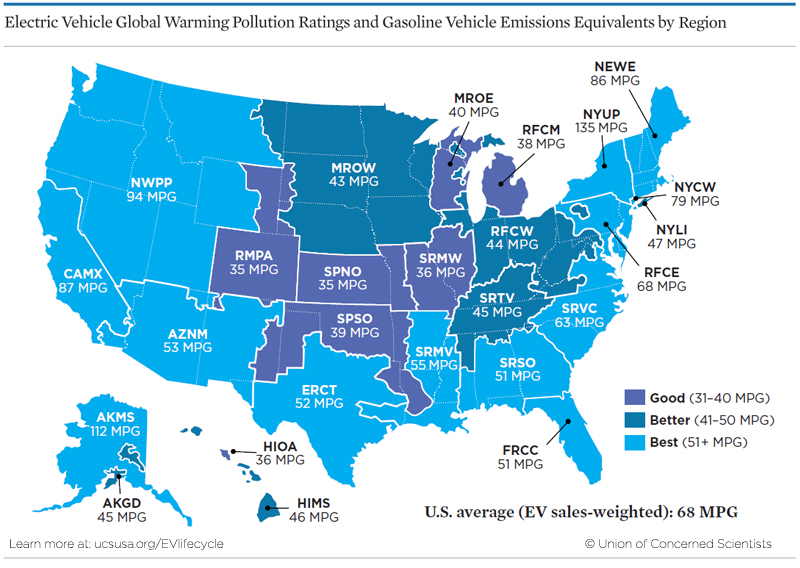
Credit: UCS blog: How to Calculate Electric Vehicle Emissions by ZIP Code and Model
The lowest fuel efficiency on the map is in Kansas with 35 mpg. The average fuel efficiency for a new passenger car in the United States is 36 mpg; for a light truck, it's 25.3 mpg, according to the Department of Transportation.
The utilities move away from coal to natural gas and renewables played a critical role in making electric vehicles cleaner. Coal-powered electricity "emits between 1.4 and 3.6 pounds of carbon dioxide equivalent per kilowatt hour (lb. CO2e/kWh)," writes USC policy analyst Josh Goldman, policy analyst. "Natural gas, by comparison, emits between 0.6 and 2 lb. CO2e/kWh."
The report accounts for the fact that "BEV [battery electric vehicle] production results in higher emissions than the making of gasoline cars—mostly due to the materials and fabrication of the BEV lithium-ion battery," writes Rachael Nealer in her UCS blog.
For an interesting read on the new report, please see David Roberts' piece in Vox.
A June CityLab article based on a working paper from the National Bureau of Economic Research presents a contrary viewpoint (posted here). The report also considers criteria pollutants and rebates given to EVs.
Hat tip: Paul Scott, EVs and Energy
Read the full story: UCS report: Cleaner Cars from Cradle to Grave (2015)

Should Electric Vehicles Be Taxed or Subsidized?
The answer depends on location, according to previous studies on EVs. The study from NBER evaluated both gas and electric-powered vehicles to determine their effect on the environment. A surprising recommendation is a new road funding option.

How the ‘Big Beautiful Bill’ Impacts Transportation
Five ways the bill negatively impacts U.S. transportation policy.
Seattle's 'Electrification Blueprint' Sets Ambitious Goals
The city's new transportation plan focuses on eliminating carbon emissions in its transportation sector, reducing congestion, and boosting public transit.

Planetizen Federal Action Tracker
A weekly monitor of how Trump’s orders and actions are impacting planners and planning in America.

Amtrak, CN end decades-long dispute with eight-year agreement
The new operating agreement establishes an updated framework for the companies to work together, including processes to resolve disputes.

Judges permit Denver to divert 77,000 acre feet from the Colorado River for reservoir expansion
Overuse and climate change have caused the Colorado River’s water levels to plummet.

NYC plants over 18,000 trees, the most new foliage in a decade
Many of the trees were planted in communities vulnerable to extreme heat.

New bill requires California data center developers to create water scarcity plans
Gov. Gavin Newsom recently signed 7 bills intended to give California communities more information about the impact of proposed data centers.

San Diego may kill one-third of its bus routes as budget crisis looms
Under the city's proposed plan, 21% of Metropolitan Transit System riders would lose access to transit services.

FREE Course: Walkable City 1: Why Walkability?
After describing his path towards focusing on walkability as the essence of good planning, Jeff Speck marches through his five principal reasons for making more walkable places.
Reinventing Malls: Planning Alchemy—Turning Gray Fields Into Gold
The course focuses on the opportunities and imperatives that shape reinvention of mall sites.

City of Wisconsin Rapids
Harvard University Graduate School of Design
KFH Group Inc.
The Architects Foundation
University of Cincinnati Online
The Pocatello Development Authority
The Urban Renewal Agency of the City of Pocatello