Reflection on the education provided by the irreverent game called Cards Against Urbanity has led the game's creators to create a new, less snarky version of the game.


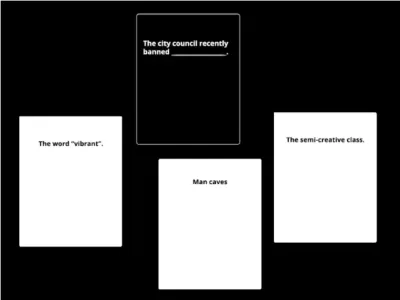
The game has proven popular enough (indeed, the news post announcing the creation of the game was the sixth most popular news story on Planetizen in 2014), that "the team behind the card game is launching a new, more serious stack of cards. Call it, if you wish, Cards For Urbanity," according to Kaufman.
"Imagine, Do Tank and Greater Places say, a Pinterest board of urban planning — but in real life. Each card will have a single concept or buzzword on it — a woonerf or a protected bike lane or sneckdown — along with an illustration and a definition. The cards are remixable and rearrangable, of course, and the team thinks everyone can use these."
Kaufman provides a lot more about the thinking behind a less snarky version of the game, especially its potential to benefit planning processes around the country. The news about the new card game comes at the one-year anniversary of the Cards Against Urbanity game.
FULL STORY: How a Not-Entirely-Polite Card Game Is Changing Urban Planning

Planners, Architects Launch 'Cards Against Urbanity'
The only thing surprising about Cards Against Urbanity, a cities- and city-planner-focused parody of Cards Against Humanity, is that nobody thought of it sooner.

Minneapolis Activists Use DIY Traffic Circles to Identify, Slow ICE
Residents are using the pop-up roundabouts to slow traffic and make their presence known on Minneapolis streets.
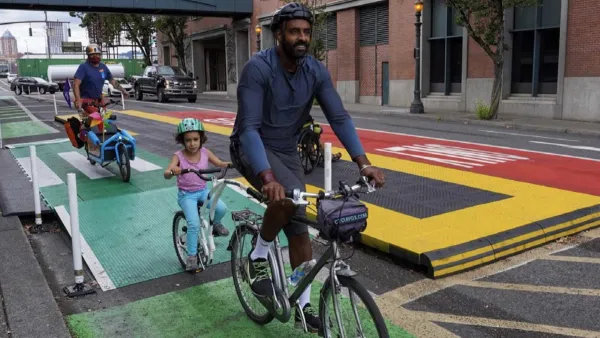
Portland Launches Tool for DIY Community Road Safety Interventions
A set of resources offers safety data and guidance for putting low-cost, quick-build interventions into action.

Planetizen Federal Action Tracker
A weekly monitor of how Trump’s orders and actions are impacting planners and planning in America.

The state-sanctioned urbicide of Austin
People don’t kill cities. Freeways do.

US to reduce Colorado River water deliveries to Mexico
A new Colorado Treaty amendment reduces Mexico’s Colorado River water allocation by 250,000 acre feet.

5 New England states march closer to 800 megawatt wind energy project
Securing federal approval for the project may be complicated under the Trump administration, which has historically been hostile towards domestic wind power.

Baltimore to break ground on $50 million Transit Priority Project
The project will bring faster bus trips, safer streets and better bike connections to Baltimore.

Airbnb launches $250 million 'last-dollar financing' housing accelerator, makes first investment in Austin
The company will put $6.4 million towards affordable housing development in Texas’ capital.

FREE Course: Walkable City 1: Why Walkability?
After describing his path towards focusing on walkability as the essence of good planning, Jeff Speck marches through his five principal reasons for making more walkable places.
Reinventing Malls: Planning Alchemy—Turning Gray Fields Into Gold
The course focuses on the opportunities and imperatives that shape reinvention of mall sites.

Eagle County Government
Harvard University Graduate School of Design
Nashville Planning Department
The Architects Foundation
University of Cincinnati Online
The Pocatello Development Authority
The Urban Renewal Agency of the City of Pocatello
Journal of the American Planning Association