The Woodward Avenue Action Association recently approved a plan for a complete streets makeover that would connect to the forthcoming M-1 streetcar and cross several city boundaries.


Eric D. Lawrence reports on the details of an ongoing planning effort by the Woodward Avenue Action Association. According to Lawrence, the association's board recently approved the Woodward Avenue Complete Streets plan, which proposes changes to Woodward Avenue from the M-1 sttreetcar line all the way to the city of Pontiac.
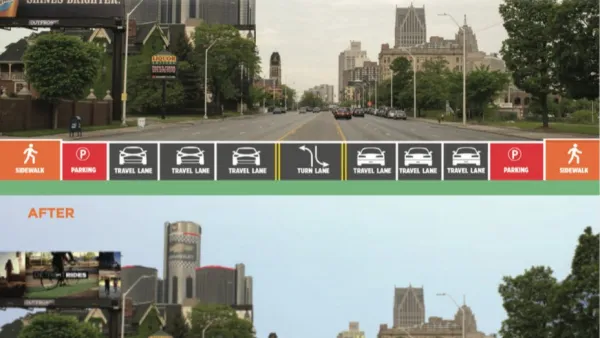
Lawrence provides details about the proposed complete streets makeover, which would vary across the length of the long stretch of road. "In the M-1 Rail vicinity, for example, bike traffic would be redirected west of Woodward to Cass Avenue, but pedestrians along Woodward would see improved crosswalks and mid-block crossings."
Farther afield from Detroit's core, "a 'Parisian boulevard' is envisioned from McNichols in Detroit, north through Ferndale, Pleasant Ridge, Huntington Woods, Berkley, Royal Oak and Birmingham, to Quarton Road in Bloomfield Township. It would provide lanes for rapid transit buses — assuming they are eventually implemented — in the center lane, and then spreading outward in both directions would be three lanes of traffic, a wide curb for trees or bioswales, a slip road for slower traffic, parking spots and protected bike lanes, or cycle tracks, at the same elevation as the sidewalk."
The plan would still face significant funding hurdles to reach implementation. Implementation is also contingent on the cooperation of the Michigan Department of Transportation. The article includes a lot more details about the politics behind this multi-jurisdictional plan.
Read the full story: The next Woodward: More bikes, more walkers, more green

Major Street Reconfiguration Underway in Detroit
A $1 million project to reduce vehicle lanes on Detroit's Jefferson Boulevard is designed to increase safety along the busy corridor.
Are Plans for Detroit's Light Rail Back On Track?
Just three weeks after the city announced it was cancelling plans for a 9.3-mile light rail line, a truncated version may be built, but with some key caveats.
Does Detroit Have a Bright Transit Future?
Jon Zemke ponders the many possibilities for building a world-class transportation network throughout metro Detroit.

Planetizen Federal Action Tracker
A weekly monitor of how Trump’s orders and actions are impacting planners and planning in America.

The state-sanctioned urbicide of Austin
People don’t kill cities. Freeways do.

US to reduce Colorado River water deliveries to Mexico
A new Colorado Treaty amendment reduces Mexico’s Colorado River water allocation by 250,000 acre feet.

Nation's most wind-powered state turns to coal as data centers increase energy demand
For the first time in decades, Iowa has increased its generation of coal power.

NYC cools commuters with city's first rain garden above a bus stop
New York City officials say the plants in the rain garden can absorb 16 gallons of rainwater during heavy storms.

Brightline West’s future may rely on $6 billion federal loan
The company has until Nov. 2 to make a $400 million equity investment into its proposed high-speed rail line.

FREE Course: Walkable City 1: Why Walkability?
After describing his path towards focusing on walkability as the essence of good planning, Jeff Speck marches through his five principal reasons for making more walkable places.
Reinventing Malls: Planning Alchemy—Turning Gray Fields Into Gold
The course focuses on the opportunities and imperatives that shape reinvention of mall sites.

Greater Baltimore Committee
Eagle County Government
Harvard University Graduate School of Design
The Architects Foundation
University of Cincinnati Online
The Pocatello Development Authority
The Urban Renewal Agency of the City of Pocatello
Journal of the American Planning Association