Local officials, planners, and other civic leaders have joined together to look at how the city can bring neighborhoods split by freeways back together again.


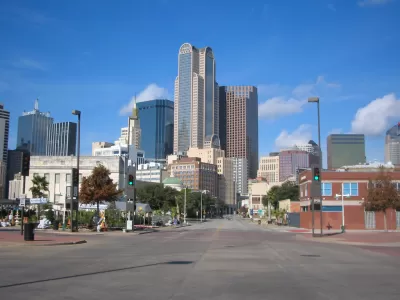
Brandon Formby reports in The Dallas Morning News on a new program lead by the Texas Department of Transportation in partnership with local planners and civic leaders. The goal of the new program called CityMAP is to produce a menu of option for how the city can begin to rebuild, tweak, or replace existing freeways surrounding downtown Dallas to overcome the freeway as a physical barrier that has separated the downtown core from surrounding neighborhoods. An existing example for innovative thinking is the city's Klyde Warren Park, built on a deck over a portion of the Woodall Rodgers Freeway, and opened in 2012. The park has become a popular spot for families and recreationists. However, future transit improvements, including the construction of a high-speed rail station and expansion of the rapid transit system through downtown, have also spurred new thinking for increasing connectivity throughout the city.
"The goal isn’t just to create more deck parks, though more could be in store. There are deeper hopes that updating major infrastructure in the urban core will restitch neighborhoods, spur developments with a dense mix of residences and job centers and give thousands of people the option to ditch their cars altogether."
Three meetings will be held in October and November to get public input on new ideas and potential solutions to create a more integrated downtown core, with the recognition that beyond just a destination, downtown has grown into a thriving live-work community.
Read the full story: CityMAP planners envision future of downtown Dallas’ aging highways

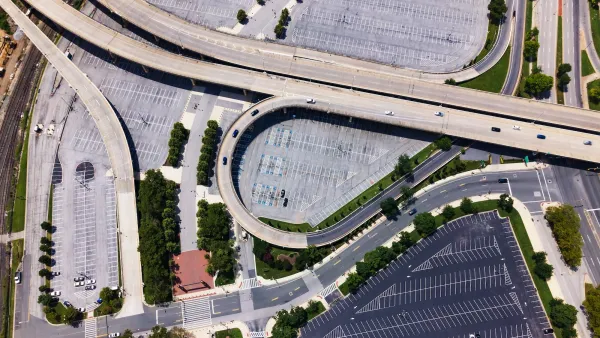
New Tool Uncovers Exact Costs of Downtown Highways
A new research tool can help cities calculate the economic potential that could be unlocked by replacing highways with other uses.
Dallas City Council to Vote on Controversial Freeway Trenching Plan
A proposal to bury part of Interstate 345 in a 65-foot trench is the latest in a debate that has lasted more than ten years as the freeway reaches the end of its useful life.
Opinion: Hit the Brakes on Dallas Freeway Plan
A proposal to bury a Dallas freeway may not be the best way forward for the area’s residents.

Planetizen Federal Action Tracker
A weekly monitor of how Trump’s orders and actions are impacting planners and planning in America.

Amtrak, CN end decades-long dispute with eight-year agreement
The new operating agreement establishes an updated framework for the companies to work together, including processes to resolve disputes.

Judges permit Denver to divert 77,000 acre feet from the Colorado River for reservoir expansion
Overuse and climate change have caused the Colorado River’s water levels to plummet.

NYC DOT wants faster, more permanent street upgrades
The city is examining ways to build more concrete infrastructure without getting entangled in 'decades-long' projects.

'Something we’ve never seen before:' rising utility rates could strain city finances nationwide
Data centers, climate change and other factors have caused utility rates in the United States to increase by 38% since 2020.

Trump to overrule local leaders, lease millions of acres of America’s Pacific Island territories’ seafloors to mining companies
International law says that the Indigenous people of America’s territories have a right to prior and informed consent regarding projects that impact their countries.

FREE Course: Walkable City 1: Why Walkability?
After describing his path towards focusing on walkability as the essence of good planning, Jeff Speck marches through his five principal reasons for making more walkable places.
Reinventing Malls: Planning Alchemy—Turning Gray Fields Into Gold
The course focuses on the opportunities and imperatives that shape reinvention of mall sites.

Harvard University Graduate School of Design
KFH Group Inc.
Greater Baltimore Committee
The Architects Foundation
University of Cincinnati Online
The Pocatello Development Authority
The Urban Renewal Agency of the City of Pocatello