A new study from the Lincoln Institute of Land Policy makes the case for well-timed, thoughtful use of inclusionary zoning as a tool to support diverse, affordable communities.


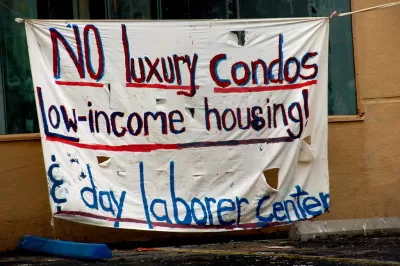
A post by Anthony Flint on the Lincoln Institute of Land Policy website announces the release of a new report titled "Inclusionary Zoning: Creating and Maintaining Equitable Communities." As noted in the post, debates about inclusionary zoning are raging in cities all over the country. The new report by the Lincoln Institute of Land Policy endeavors to "[separate] myth from fact, charting a path forward for policymakers and showing how inclusionary housing can be used effectively to reduce economic segregation."
More specifically, according to Flint, "author Rick Jacobus of Cornerstone Partnership offers solutions for overcoming the major political, technical, legal and practical barriers to successful inclusionary housing programs," after providing a review of literature and case studies.
Randy Billings already picked up on the news of the new report for the Portland Press Herald, indicating the relevance of inclusionary zoning to housing policy in Maine's largest city. "The [Maine] City Council is also considering adopting an inclusionary zoning ordinance," reports Billings. "Even though the proposed ordinance received a negative recommendation from the Planning Board, several councilors continue to support the proposal, which they will take up at a meeting in October."
Read the full story: Making inclusionary housing work


Pittsburgh Lawsuit Threatens Affordable Housing Requirement
A suit brought by a developers’ group calls the cost burden of the city’s inclusionary zoning law ‘unconstitutional.’

San Francisco to Reconsider Inclusionary Zoning as Development Slows to a Crawl
Critics of inclusionary zoning frequently point to San Francisco as an example of what not to do. A sluggish year of development has some local politicians ready to reconsider the city’s program.

Inclusionary Zoning Adopted in L.A. County
The county of Los Angeles is looking for policy tools that will add affordable housing units to the housing market. Inclusionary zoning is its policy of choice.

Planetizen Federal Action Tracker
A weekly monitor of how Trump’s orders and actions are impacting planners and planning in America.

‘Going backwards:’ Baltimore mayor, students rally against state's transit funding plan
Maryland's proposed six-year plan provides no funding for Baltimore’s BMORE bus program and reduces its road maintenance funding.

Detroit to transform waterfront with $2.2 billion investment
Developers will convert about 18 acres of unused parking lot space into civic spaces.

Planned $2 billion courthouse in MA sparks tension with local government
Springfield owns an essential piece of the land developers intend to build on, and some city officials do not want to see the project come to fruition.

Californians can now transform balconies into power generators
Gov. Gavin Newsom has legalized plug-in solar technology, which allows residents to plug solar panels directly into their outlets

This 85-year-old ranch is Texas’ newest state park
The 650 acre ranch is one of the largest parcels of land along Lake Palestine.

FREE Course: Walkable City 1: Why Walkability?
After describing his path towards focusing on walkability as the essence of good planning, Jeff Speck marches through his five principal reasons for making more walkable places.
Reinventing Malls: Planning Alchemy—Turning Gray Fields Into Gold
The course focuses on the opportunities and imperatives that shape reinvention of mall sites.

City of Thousand Oaks
City of Wisconsin Rapids
Harvard University Graduate School of Design
The Architects Foundation
University of Cincinnati Online
Northern Illinois Transit Authority (NITA)
The Pocatello Development Authority
The Urban Renewal Agency of the City of Pocatello