As ridership grows on the Southeastern Pennsylvania Transportation Authority (SEPTA) rail system, system planners are looking to a novel approach to relieve crunched station parking: bikes.


Jen Kinney reports: "With bicycling rates in Philadelphia more than doubling in the last 20 years and public transportation ridership at a 25-year high, the Southeastern Pennsylvania Transportation Authority (SEPTA) is looking for ways to bring these two modes of transit together."
"The agency’s first Cycle-Transit Plan [pdf], released this year, explores policy and infrastructure changes that could make it easier for riders to combine bicycling and public transportation in one commute. It’s one of just a few formal cycle-transit integration plans in the country."
In addition to the plan, SEPTA also has $3 million budgeted for the installation of new bike shelters "at 15 stations every year for the next three years," according to Kinney. The article includes more detail about the planning process behind the Cycle-Transit plan as well as more of the improvements commuters can expect when moving between the bike and the train on the SEPTA system.
Read the full story: Philly Gets Ahead on the Bike-Plus-Train Commute

$3 Million for Bike Stations Backs Up SEPTA's Bike Planning Efforts
The Southeastern Pennsylvania Transportation Authority (SEPTA) recently released the budget that will back up the components of its first ever bike plan: the SEPTA Cycle-Transit Plan, released in April 2015.
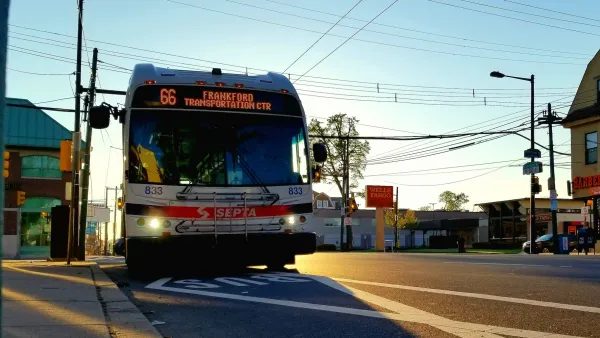
SEPTA's bus-mounted lane enforcement cameras cut travel times by up to 6%
The AI-assisted cameras have issued nearly 200,000 citations to drivers blocking bus lanes.
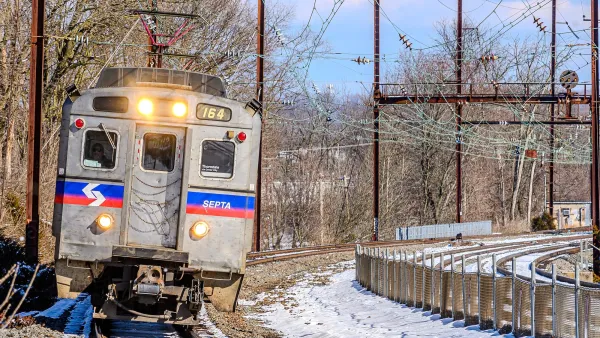
SEPTA Borrows Maryland's Rail Cars to Replace Fleet That Kept Catching Fire
The agency’s efforts to repair its Silverliner fleet is being hampered by supply chain delays.

Planetizen Federal Action Tracker
A weekly monitor of how Trump’s orders and actions are impacting planners and planning in America.

California plans to bury El Niño’s downpour
If the state plays its cards right, it may be able to store a billion acre-feet of El Niño’s water in aquifers.

Chicago breaks ground on $3 billion megadevelopment
The new neighborhood, titled Foundry Park, will one day host 3,700 residences.

Satanic place names
From streams and lakes to valleys and canyons, I mapped more than 1,000 places named after the Devil.

California High-Speed Rail Authority CEO resigns after $600,000 scandal
Under Ian Choudri, the authority used taxpayer dollars to fund first class flights and trips to nightclubs.

Want to study the Missouri River? Soon, you may need unanimous approval from 10 states
Legislation would require 10 governors’ permission to study or build projects moving water outside the basin.

FREE Course: Walkable City 1: Why Walkability?
After describing his path towards focusing on walkability as the essence of good planning, Jeff Speck marches through his five principal reasons for making more walkable places.
Reinventing Malls: Planning Alchemy—Turning Gray Fields Into Gold
The course focuses on the opportunities and imperatives that shape reinvention of mall sites.

City of Rosemead
Rutgers University, Edward J. Bloustein School of Planning and Public Policy
One Hundred Miles
Hunter College, City University of New York (CUNY)
The Architects Foundation
University of Cincinnati Online
City of Cambridge
Montrose County
The Pocatello Development Authority