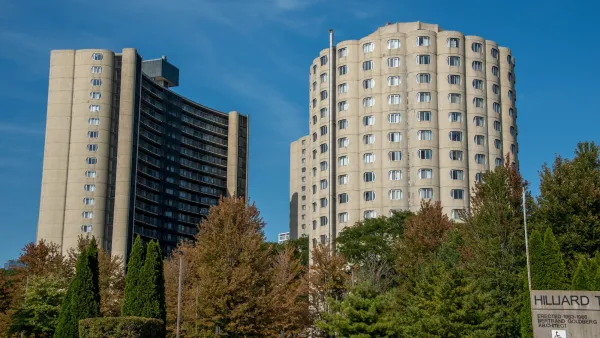
The U.S. Department of Housing and Urban Development has shifted its response to an audit finding tens of thousands "over-income" residents living in subsidized housing.


"The Department of Housing and Urban Development said Tuesday that in response to an unsparing audit by its watchdog, it’s urging public housing authorities across the country to kick out tenants who make too much money to qualify for government subsidies," reports Lisa Rein.
The audit, by the office of Inspector General David Montoya, found that "more than 25,000 tenants earn more than the maximum income to get into public housing –almost half of them making $10,000 to $70,000 more," according to Rein.
The decision to evict "over-income" families marks a shift from the initial response to the audit from HUD. "HUD’s deputy assistant secretary for public housing and voucher programs had denounced the report before its release in late July as contradicting HUD policy, which allows 'over-income' families to stay because evicting them could destabilize their progress toward self-sufficiency."
The article goes into how HUD might address the dual goals of public housing—economic diversity and affordable housing—in the future so that they aren't as likely to contradict with each other.
Read the full story: After criticism, HUD says it’s trying to give the boot to public housing families who earn too much money
HUD Threatens Sanctions for Housing Authorities That Don’t Verify Resident Immigration Status
The Trump administration continues its crackdown on undocumented immigrants, claiming it is “rooting out abuse of taxpayer-funded resources.”

Troubled Houston housing agency announces plan to resolve 'material deficiencies'
The newly renamed Housing Alliance Houston has created a new accounting team and instituted new tenant file inspections, per a recent update required by HUD.

NYC mayor announces plan to repair, restore and build new public housing
Roughly 300,000 New Yorkers live in the city's public housing system.

Desperate measures: Advocates weigh draining Lake Powell to fill Colorado River
Draining the reservoir could reduce evaporation losses by a couple hundred thousand acre-feet.

Eastern Nebraska is running out of electricity
Data centers and electrification are straining eastern Nebraska’s grid, throttling economic development.

Move over, LA: St. Louis gears up for Olympics, invests millions in downtown redevelopment
The Missouri city will host the 2028 Olympic soccer group stage and knockout matches.

Maryland’s $15 billion bridge project gains key approval
The Maryland Transit Authority said the project will create over 60,000 jobs and add $23 billion to the local economy.

‘No clear next steps’ for Chicago's permanent festival grounds
Eleventh Ward Ald. Nicole Lee has suggested Soldier Field as a possible location for the permanent event space.

California, Hawaii, Rhode Island approve housing propositions
Hawaii and Rhode Island each approved their sole proposition, while California approved two of its three.

FREE Course: Walkable City 1: Why Walkability?
After describing his path towards focusing on walkability as the essence of good planning, Jeff Speck marches through his five principal reasons for making more walkable places.
Reinventing Malls: Planning Alchemy—Turning Gray Fields Into Gold
The course focuses on the opportunities and imperatives that shape reinvention of mall sites.

City of Rosemead
Rutgers University, Edward J. Bloustein School of Planning and Public Policy
One Hundred Miles
University of Michigan School for Environment and Sustainability (SEAS)
Hunter College, City University of New York (CUNY)
The Architects Foundation
City of Cambridge
Montrose County
The Pocatello Development Authority