We all travel, so it's great when a handy new mobile app makes it easier to move around. Whether it is navigating the city, parking, or making our ride safer, there is likely a transportation app for that.



We all travel, so it's great when a handy new mobile app makes it easier to move around. Whether it is navigating the city, parking, or making our ride safer, there is likely a transportation app for that. Edgar Ables, a bachelor's student in city and regional planning, spent part of his summer internship researching the latest mobile apps of interest to planners. The following are a few recent apps that may make your travels easier.
There are a couple of new navigation apps that aim to improve the mobility experience.
- Urban Engines (Android and iOS) is a navigation app that seeks to aggregate transportation options. For example, I often get frustrated as a cyclist because I cannot create a route in Google Maps that combines bicycling and transit. In Urban Engines, users drag and drop the location and destination pins and the app draws a smart path between the locations, allowing the user to select the desired modes of travel and the app provides the most efficient transportation route. The app is currently available in Boston, Chicago, Los Angeles, New York, Portland, San Francisco, Seattle, and Washington, D.C.
- Walkonomics (iOS) is a new app that allows users to create the most walkable route to their destination in seven cities around the world, including New York and San Francisco in the United States. The walkability is based on road safety, presence of sidewalks, pedestrian crossings, hilliness, etc.
Parking Panda (Android and iOS) allows drivers to make a parking reservation in advance in participating garages and parking lots, as well as with individuals for a parking spot in their driveway. Drivers simply pay for the parking via their smartphone. The MonkeyParking app provides a similar service in California and Boston, but also includes public parking spaces. Yet, city officials are concerned about these apps. In San Francisco, the city attorney issued cease and desist orders to apps that charge for finding public parking. (MonkeyParking subsequently released a new version based on a new business model that auctions driveway space.) The Los Angles City Council has requested a city regulation banning digital media applications that identify available parking on city streets and charge fees for the reservation of the spot. The City Council believes that these companies are taking a public asset, on street parking, and effectively privatizing public parking. The city does cooperate with information sharing apps, such as Parker (Android and iOS), that alerts drivers to open, metered spaces on city streets—the big difference is Parker does not charge for the service.

And what do you do when you see someone illegally parked? TowIt (Android and iOS) allows users to post photos of potentially illegally parked cars. When a user sees a parking offender, they can snap a photo of the vehicle, including the license plate, and upload it to the TowIt website. If parking authorities are monitoring the site they can issue a citation. The app is actively being used in cities across the country.
A number of app developers are seeking to improve safety on our roadways. Bike Shield (Android and iOS) alerts users with an alarm when a bicycle is nearby. Bicyclists and motorists alike can download the app. A user simply turns it on and leaves it on. The app sends an alert to the vehicle driver when they are a few seconds before approaching a bicycle. The app is free for riders and drivers with the hope of making city streets safer.
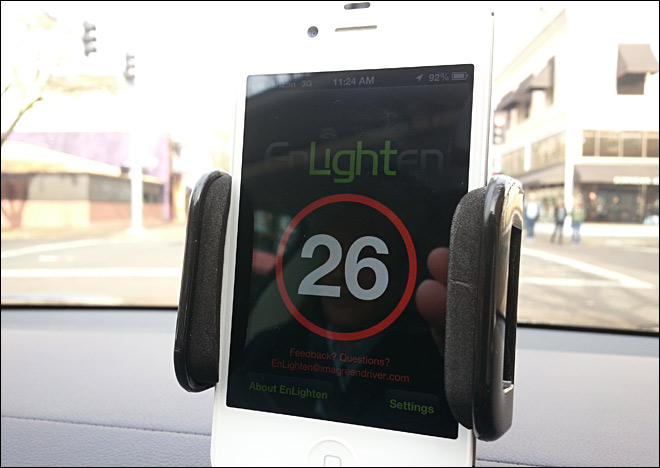
In the realm of extreme convenience. Drivers can use EnLighten (Android and iOS), which chimes a few seconds before a red light will change to green. The goal is to help refocus drivers on driving. That is to get them to look up from their phone, stereo or other distraction. The app is connected to a city's traffic lights. EnLighten is currently in use in Portland and Eugene, Oregon; Salt Lake City, Provo, and Ogden, Utah; Las Vegas, Nevada; and Arcadia and Walnut Creek, California. I'm not sure whether this would encourage additional distractions by looking at a phone or improve safety. What do you think?

Enabling Travel Through Your Smartphone: Mobility as a Service
Imagine on your phone being able to wake up and with a simple click be able to arrange all of your transportation needs for the day. Soon your bus pass, carsharing pass, bikesharing pass, and your personal vehicle will go away—replaced by an app.
The Best Planning Apps for 2016
A list of mobile apps that support planning, as part of an annual update. Learn about exciting new ways to explore cities and enhance planning via mobile apps. Please feel free to add your own favorites.

Create Your Own Mobile Planning App
Ever wonder how you could create your own mobile app. This blog post shares tools that make it possible for planners to create apps, along with an example of Chip-In, an app focused on harnessing volunteer resources in communities.

Planetizen Federal Action Tracker
A weekly monitor of how Trump’s orders and actions are impacting planners and planning in America.

Amtrak, CN end decades-long dispute with eight-year agreement
The new operating agreement establishes an updated framework for the companies to work together, including processes to resolve disputes.

Judges permit Denver to divert 77,000 acre feet from the Colorado River for reservoir expansion
Overuse and climate change have caused the Colorado River’s water levels to plummet.

NYC DOT wants faster, more permanent street upgrades
The city is examining ways to build more concrete infrastructure without getting entangled in 'decades-long' projects.

'Something we’ve never seen before:' rising utility rates could strain city finances nationwide
Data centers, climate change and other factors have caused utility rates in the United States to increase by 38% since 2020.

Trump to overrule local leaders, lease millions of acres of America’s Pacific Island territories’ seafloors to mining companies
International law says that the Indigenous people of America’s territories have a right to prior and informed consent regarding projects that impact their countries.

FREE Course: Walkable City 1: Why Walkability?
After describing his path towards focusing on walkability as the essence of good planning, Jeff Speck marches through his five principal reasons for making more walkable places.
Reinventing Malls: Planning Alchemy—Turning Gray Fields Into Gold
The course focuses on the opportunities and imperatives that shape reinvention of mall sites.

Harvard University Graduate School of Design
KFH Group Inc.
Greater Baltimore Committee
The Architects Foundation
University of Cincinnati Online
The Pocatello Development Authority
The Urban Renewal Agency of the City of Pocatello

