The infamous MonkeyParking app that last year ran afoul of public sentiment and the law is back with a new business model that offers residents the chance to auction that most precious of commodities—urban parking space.


"This month, MonkeyParking quietly returned to San Francisco in a below-the-radar beta mode," reports Joe Eskenazi. The re-appearance of the app includes an all new business model. According to Eskenazi, "[in] its new model, rather than enable users to peddle public property—which is both illegal and morally dodgy—MonkeyParking is now focused on private property: driveways, to be specific. If you pull out of and pull into your driveway for five minutes a day, [MonkeyParking CEO Paolo] Dobrowolny says, then a valuable resource is lying fallow for 23 hours and 55 minutes a day."
Eskenazi cites a deputy San Francisco city attorney to note that the new business model is, in fact, legal, unlike its predecessor, which would have auctioned off public parking spaces.
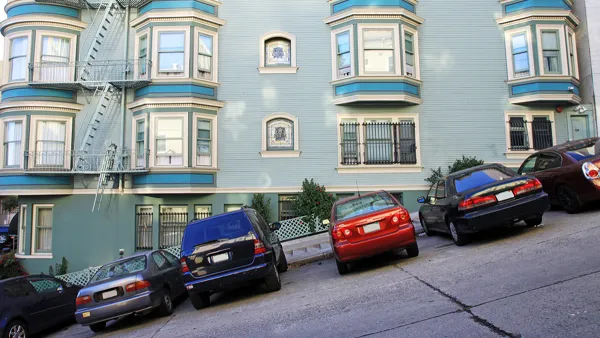
The opportunity for the 100 test users enlisted by MonkeyParking to test the new model in San Francisco is actually the space on the street in front of the driveway, where property owners are allowed to park or grant others permission to park, because most driveways in the city are not large enough to fit a car without blocking the sidewalk.
Read the full story: MonkeyParking Is Back and Ready to Disrupt Your Driveway

Monkey Parking is Monkey Business, Warns San Francisco City Attorney
A "cease-and-desist letter" was sent June 23 to MonkeyParking, a Rome-based tech startup that developed and markets an app that allows motorists to auction public parking spaces beginning at $5. The city attorney demanded shut-down by July 11.
Mudslinging over Parking Apps in San Francisco
A San Francisco city attorney spokesman used some colorful language in response to MonkeyParking's recent act of defiance against the city.
New App Would Auction Public Parking Spaces
The MonkeyParking app works similarly to sharing economy stars Airbnb or Uber, except for sale is an inside line on parking spaces. That means that private users would be auctioning the use of public space. That can't be legal, can it?

Planetizen Federal Action Tracker
A weekly monitor of how Trump’s orders and actions are impacting planners and planning in America.

Amtrak, CN end decades-long dispute with eight-year agreement
The new operating agreement establishes an updated framework for the companies to work together, including processes to resolve disputes.

Judges permit Denver to divert 77,000 acre feet from the Colorado River for reservoir expansion
Overuse and climate change have caused the Colorado River’s water levels to plummet.

NYC DOT wants faster, more permanent street upgrades
The city is examining ways to build more concrete infrastructure without getting entangled in 'decades-long' projects.

'Something we’ve never seen before:' rising utility rates could strain city finances nationwide
Data centers, climate change and other factors have caused utility rates in the United States to increase by 38% since 2020.

Trump to overrule local leaders, lease millions of acres of America’s Pacific Island territories’ seafloors to mining companies
International law says that the Indigenous people of America’s territories have a right to prior and informed consent regarding projects that impact their countries.

FREE Course: Walkable City 1: Why Walkability?
After describing his path towards focusing on walkability as the essence of good planning, Jeff Speck marches through his five principal reasons for making more walkable places.
Reinventing Malls: Planning Alchemy—Turning Gray Fields Into Gold
The course focuses on the opportunities and imperatives that shape reinvention of mall sites.

Harvard University Graduate School of Design
KFH Group Inc.
Greater Baltimore Committee
The Architects Foundation
University of Cincinnati Online
The Pocatello Development Authority
The Urban Renewal Agency of the City of Pocatello