One World Trade Center's long-awaited observatory opened May 29. Located on floors 100, 101 and 102 of the tower, the 47-second elevator trip is as remarkable as the sites from the 1,250 foot high observatory.


"Instead of a head-spinning and possibly stomach-churning view of the city from the elevators, visitors – *paying $32 (£21) for the experience – are treated to a multimedia visual display of 500 years of Manhattan history, from its days as a forested island to today’s urban jungle of skyscrapers and canyon," writes Philip Sherwell of The Telegraph.
"The Sky Pod lifts are worth the price of admission alone," writes The Telegraph's Mark C. O’Flaherty in the Travel section.
The mechanics make the actual elevation process and accompanying speed nearly imperceptible. There are no windows, but surrounding video screens immerse you in a dazzling virtual thrill-ride showing New York’s rapidly changing cityscape from 1500 to today; as the lift travels higher and higher, bridges are built and buildings rise below you.
The elevators were built by "ThyssenKrupp, a German multi-national conglomerate which has worked on the project for five years," writes The Telegraph's Andrew Trotman.
The 3.5m visitors a year wanting to travel to the Observation Deck after it opens on May 29 will take one of five elevators that are believed to be the fastest in North America. Each cab travels at 23mph, and will move from the ground to the 102nd floor in just 60 seconds. [Sherwell states it takes 47 seconds].
As for the sights from the observatory, "(o)n a clear sunny day this week, the awe-inspiring panoramic view stretched from the harbour to the south, taking in the Statue of Liberty and the Staten Island ferries churning the waters; west across the new skyscrapers of Jersey City, built by companies that fled the city after 9/11; north towards the thick concrete sprawl of Manhattan, with the landmark pinnacles of the Empire State and Chrysler buildings; and east to the burgeoning new neighbourhoods of Brooklyn," writes Sherwell.
"In comparison to the cage-like 86th floor Observation Deck of the Empire State in Midtown, these floor-to-ceiling glass spaces feel like the future," writes O’Flaherty.
*Some need not pay: "One World Observatory will offer complimentary admission to 9/11 family members and the rescue and recovery workers who responded on 9/11 and in the months after," writes Josh Einiger of ABC 7 News. Also, reduced rates for seniors, youths, and no charge for children five years of age and younger.
There is no charge for admission to the 9/11 Memorial. Tickets are needed for the National September 11 Memorial Museum.
Finally, anyone can tour the third largest transit terminal in New York: the $4 billion World Trade Center Transportation Hub, built for the PATH train and 11 subway lines and connected to the Battery Park City Ferry Terminal. According to its website, "it offers the most integrated network of underground pedestrian connections in New York City." You can't miss seeing the controversial Oculus structure.
Read the full story: New World Trade Centre observatory opens, banishing memories of the Twin Towers
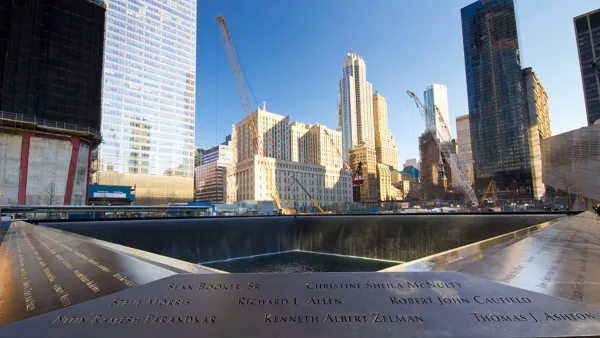
Is the 9/11 Memorial a 'Dead Space' in Lower Manhattan?
The grand opening of the 9/11 memorial and museum is derided by critics as a cold, uninviting public space, and 'ritualizing grief on a loop'
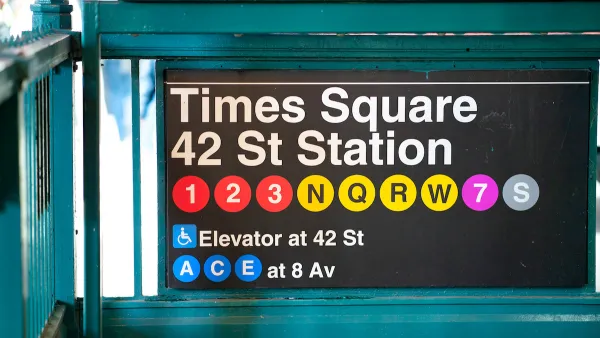
Report: NYC Transit Falling Behind on Accessibility
The city is lagging on meeting its pledge to improve accessibility across the system.
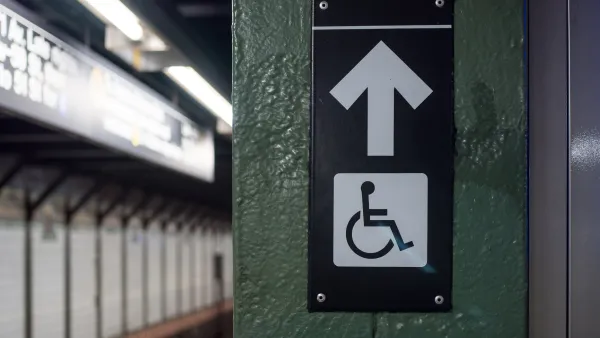
New York Must Make Almost All Subway Stations Accessible by 2055, Judge Rules
Another recent ruling is forcing the agency to accelerate its efforts to make all New York subway stations accessible to people with disabilities and mobility issues.

Planetizen Federal Action Tracker
A weekly monitor of how Trump’s orders and actions are impacting planners and planning in America.

California plans to bury El Niño’s downpour
If the state plays its cards right, it may be able to store a billion acre-feet of El Niño’s water in aquifers.

Desperate measures: Advocates weigh draining Lake Powell to fill Colorado River
Draining the reservoir could reduce evaporation losses by a couple hundred thousand acre-feet.

Mamdani’s pied-à-terre tax survives legal challenge
A panel of judges found that the plaintiffs failed to demonstrate injury as a result of New York City's implementation of the tax.

Eastern Nebraska is running out of electricity
Data centers and electrification are straining eastern Nebraska’s grid, throttling economic development.

Seattle passes record-breaking transit services expansion
Proposition 1 will double the city’s transit tax to add 95,000 more bus trips and preserve 180,000 bus trips annually.

FREE Course: Walkable City 1: Why Walkability?
After describing his path towards focusing on walkability as the essence of good planning, Jeff Speck marches through his five principal reasons for making more walkable places.
Reinventing Malls: Planning Alchemy—Turning Gray Fields Into Gold
The course focuses on the opportunities and imperatives that shape reinvention of mall sites.

City of Rosemead
Rutgers University, Edward J. Bloustein School of Planning and Public Policy
One Hundred Miles
University of Michigan School for Environment and Sustainability (SEAS)
Hunter College, City University of New York (CUNY)
The Architects Foundation
City of Cambridge
Montrose County
The Pocatello Development Authority