Pittsburgh Planning Director Ray Gastil was profiled by Pittsburgh Magazine.



Patrick Doyle pens an in-depth profile of Pittsburgh Planning Director Ray Gastil—avid cyclist, historian, and aficionado of Pittsburgh's many public spaces.
As for policy, Doyle describes Gastil's efforts to integrate into his adopted city:
"Gastil arrived in Pittsburgh in April 2014 from Seattle — his resume plucked out of The Pittsburgh Foundation’s “Talent City” application pool for work in Mayor Bill Peduto’s administration — with a loose understanding of the challenges that awaited him here. In the time that he’s been here, however, he says he’s begun clarifying his vision. He’s beginning to consider tweaks to the city’s zoning plan — as appropriate — in order to streamline both commercial and residential developments by dialing back rules that seem to require a variance for just about everything. In the planning department, he’s filled vacant neighborhood-level positions so that communities now have a point person with the city.
"Most of all, though, he’s working on making stronger connections between neighborhoods and the riverfronts, increasing development around transit-oriented hubs and increasing both the bike- and pedestrian-friendliness of the city. He’s intricately involved with a pair of initiatives that Peduto announced in March — the $32 million “complete streets” Envision Downtown program and The Heinz Endowments-funded p4, for “People, Planet, Place, Performance,” program for sustainable urban growth."
The article also includes quotes from Pittsburgh Mayor Bill Peduto and former Mayor Tom Murphy on the potential of planning directors to shape a positive vision for Pittsburgh and other cities. Doyle also spares no detail on the places and recent planning decisions that will have the most impact on Pittsburgh during Gastil's tenure.
Hat tip to Jenn Stanley for sharing the article.
Read the full story: What Inspires Ray Gastil's Careful Plan for Pittsburgh's Future - See more at: http://www.pittsburghmagazine.com/Pittsburgh-Maga
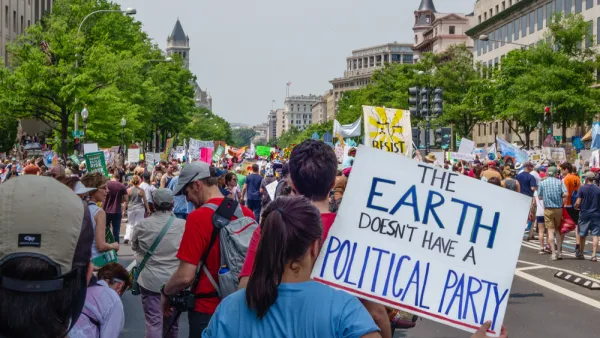
Climate Mayors Make Their Case to Climate Senators at their First Hearing
Five "climate mayors" addressed the Senate Democrats’ Special Committee on the Climate Crisis at their fist hearing on July 17, titled, “A Blueprint for Success: U.S. Climate Action at the Local Level.” Transportation was a major issue.

Advocates Press for Harder Questions While Pittsburgh Experiments With Self-Driving Cars
Five self-driving car companies are currently operating in Pittsburgh, without much critical rigor in asking about the consequences of the technology to the city.

Pittsburgh's Big Development Plans Ready to Switch Gears
There are plenty of big, splashy projects to track in Pittsburgh's development pipeline.

Planetizen Federal Action Tracker
A weekly monitor of how Trump’s orders and actions are impacting planners and planning in America.

Eastern Nebraska is running out of electricity
Data centers and electrification are straining eastern Nebraska’s grid, throttling economic development.

Study reveals best places in the U.S. for cycling, walking
New research from Streetlight Data examines bicycle and pedestrian miles per capita in the 100 largest U.S. cities by population.

DSA members accuse Mamdani of 'abandoning values' over housing redevelopment
New York City's mayor plans to replace about 2,000 units of public housing with private, mixed-income housing.

All sides of BRT debate unhappy with CDOT’s most recent move
The Colorado Department of Transportation is no longer considering center-running bus lanes for Colorado Boulevard.

Massachusetts bogs generate both power, and cranberries
Putting solar panels above farmland is one way Massachusetts is advancing toward its goal of net-zero carbon emissions by 2050.

FREE Course: Walkable City 1: Why Walkability?
After describing his path towards focusing on walkability as the essence of good planning, Jeff Speck marches through his five principal reasons for making more walkable places.
Reinventing Malls: Planning Alchemy—Turning Gray Fields Into Gold
The course focuses on the opportunities and imperatives that shape reinvention of mall sites.


City of Rosemead
Rutgers University, Edward J. Bloustein School of Planning and Public Policy
One Hundred Miles
University of Michigan School for Environment and Sustainability (SEAS)
Hunter College, City University of New York (CUNY)
The Architects Foundation
City of Cambridge
The Pocatello Development Authority
The Urban Renewal Agency of the City of Pocatello