Subway ridership statistics for 2014 were cause for celebration at the Metropolitan Transportation Authority (MTA), but the city's bus lines are not experiencing the same growth in popularity.


Stephen Miller sums up New York City's transit dichotomy: "While subway ridership hit a 65-year high last year, the story for surface transit in NYC is different. Bus ridership has yet to recover from a major round of service cuts in 2010, and in 2014 it lost some ground, according to new stats from the MTA."
The MTA announced last week the 65-year high in ridership, precipitated by a 2.6 percent rise in subway ridership to 1.751 billion customers in 2014. Obviously, the news is good for the system, though it leaves population growth out of the equation—that is to say that per capita subway ridership or mode share might be a better way to measure the growth of subway use in the city. An earlier article by Miller breaks down the subway statistics to the neighborhood level as well as making political points about the state's support of system maintenance.
Miller's recent article devotes more attention to the other untold story of New York City public transit—the bus system, which has been in steady decline for year, including last year's "record breaking" year. According to Miller, the decline in bus ridership was especially strong in Manhattan and Brooklyn, though bus ridership did increase in the Bronx and Staten Island.
Read the full story: As Subway Trips Climb, MTA Bus Ridership Continues to Stagnate
MTA Poised to Break Ridership, On-Time Service Records
New York City’s transit system saw strong increases in ridership and improvements in service quality in the first half of 2025.
NYC Bus Service Hindered by Congestion
Sharing lanes with car traffic may make it impossible for the MTA to increase service frequency.
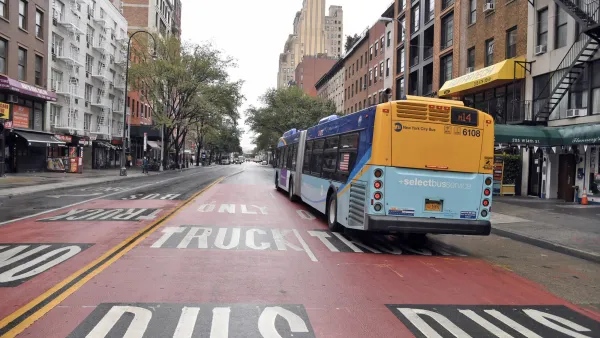
New York City’s Buses Are Speeding Up
New York City’s Metropolitan Transportation Authority is renewing efforts to create more bus lanes and dedicated busways in the city.

Planetizen Federal Action Tracker
A weekly monitor of how Trump’s orders and actions are impacting planners and planning in America.

California plans to bury El Niño’s downpour
If the state plays its cards right, it may be able to store a billion acre-feet of El Niño’s water in aquifers.

Desperate measures: Advocates weigh draining Lake Powell to fill Colorado River
Draining the reservoir could reduce evaporation losses by a couple hundred thousand acre-feet.

US buildings threatened, destroyed by fires set to triple by 2060
Researchers found a high fire risk for socioeconomically vulnerable neighborhoods in the American West.

LA residents may be allowed to paint their own crosswalks
Councilwoman Katy Yaroslavsky put out a motion instructing the Los Angeles Department of Public Transportation to study the feasibility of allowing volunteers to paint crosswalks.

Dallas moves to overhaul its zoning code
The city's zoning reform will allow more multi-family and mixed-use developments.

FREE Course: Walkable City 1: Why Walkability?
After describing his path towards focusing on walkability as the essence of good planning, Jeff Speck marches through his five principal reasons for making more walkable places.
Reinventing Malls: Planning Alchemy—Turning Gray Fields Into Gold
The course focuses on the opportunities and imperatives that shape reinvention of mall sites.

City of Rosemead
Rutgers University, Edward J. Bloustein School of Planning and Public Policy
One Hundred Miles
Hunter College, City University of New York (CUNY)
The Architects Foundation
University of Cincinnati Online
City of Cambridge
Montrose County
The Pocatello Development Authority