Mayor Rahm Emanuel, busy on the campaign trail for re-election this week, made a big push for infrastructure investments at the neighborhood level.


"In his fifth and final policy address laying out his second term agenda, Mayor Rahm Emanuel today outlined his plan to continue critical infrastructure investments in neighborhoods across the city," according to an announcement from the Rahm campaign website.
"Looking ahead, Mayor Emanuel highlighted three key areas for infrastructure improvements: providing safe and efficient transit options; expanding access to parks and recreational areas; and creating more anchors for economic growth in Chicago’s neighborhoods."
The announcement specifically mentions the following proposals, including some with very recent developments:
- The $500 million rehabilitation of Union Station, which recently received a $12 million promise for funding from Amtrak.
- New and rehabilitated stations along the Red Line and the Blue Line.
- 50 miles of new "better bike lanes."
- Expansion of Divvy bikeshare.
- Opening Chicago Public School playgrounds after school and on weekends in addition to building more than three-dozen parks in underserved neighborhoods.
- A new rails-to-trails project targeted for Little Village, Pilsen, or Englewood.
Read the full story: PRESS RELEASE: Mayor Emanuel Unveils Next Phase of ‘Building a New Chicago’
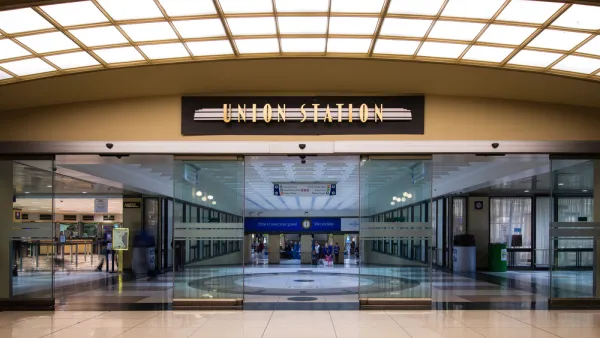
First on Chicago's Wish List from the Trump Administration: $1 Billion for Union Station
The Emanuel Administration has yet to secure needed funding for a big project to update Chicago's Union Station. Now it's up to the Trump Administration to supply a needed loan.
Double-Checking Chicago's Ambitious Bike Lane Plans
Checking in on the status of Chicago's ambitious plans to add 645 miles of bike lanes by 2020, one journalist finds a number of bikers who are questioning some of the choices made by planners.
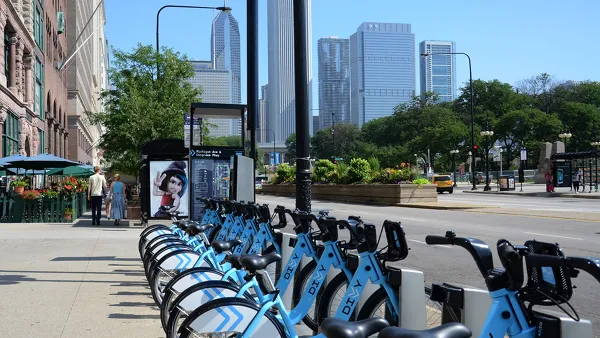
Chicago Accumulating Bike-Friendly Bonafides
Chicago officials hope that nearly 5 percent of the city's commutes will be by bike in 2020. The goal requires a lot more work (biking's share of daily trips rose to 1.3 percent in 2012 from 0.5 percent in 2000), but there are many signs of a shift.

Planetizen Federal Action Tracker
A weekly monitor of how Trump’s orders and actions are impacting planners and planning in America.

Eastern Nebraska is running out of electricity
Data centers and electrification are straining eastern Nebraska’s grid, throttling economic development.

Washington state to charge fee to drivers with fuel-efficient cars
Revenue from the fee will go towards supporting the state’s highways.

Instead of building new housing, LA developers are turning mansions into mega-mansions
In the richest areas, the number of houses valued at $30 million with demolition permits has skyrocketed since 2018.

Illinois considers spending $1 billion in taxpayer money on data center
A quantum computing campus and data center are currently under construction in Chicago.

As development costs rise, Boston moves to lessen affordable housing requirements
The Boston Zoning Commission and the City Council still need to approve Boston Mayor Michelle Wu’s proposed changes

FREE Course: Walkable City 1: Why Walkability?
After describing his path towards focusing on walkability as the essence of good planning, Jeff Speck marches through his five principal reasons for making more walkable places.
Reinventing Malls: Planning Alchemy—Turning Gray Fields Into Gold
The course focuses on the opportunities and imperatives that shape reinvention of mall sites.

City of Charlotte
City of Rosemead
Rutgers University, Edward J. Bloustein School of Planning and Public Policy
University of Michigan School for Environment and Sustainability (SEAS)
Hunter College, City University of New York (CUNY)
The Architects Foundation
University District Partnership
City of Cambridge
The Pocatello Development Authority