Conventional traffic safety programs emphasize ways that individuals can help reduce their risk, but new research indicates that safety depends largely on community planning decisions that affect how and how much people drive.


I hope that my article, "A New Transit Safety Narrative," recently published in the Journal of Public Transportation, will change the way people think about transportation risks and reform traffic safety programs. The study shows that public transit is, overall, a relatively safe (low crash risk) and secure (low crime risk) travel mode, and that per capita crash casualty rate tend to decline as transit ridership increases in a community. Transit improvements and transit-oriented development should therefore be recognized as traffic safety strategies.
These findings have been discussed in various blogs, including StreetBlog’s "Here’s How Much Safer Transit Is Compared to Driving," and Clean Technica’s "The Truth Of How Safe Transit Is Compared To Driving." Both include the graph below which compares crash rates per passenger-mile of transit, automobiles, and trucks. This generated considerable reader debate about the merits of automobile versus transit travel. Unfortunately, this misses the key point of my article.

My research emphasizes that traffic safety is significantly affected by community planning decisions, such as land use policies and roadway design that affect the amount that people drive, so risks should be measured per capita rather than per mile or kilometer of travel.
To understand this point, look at the graph below, which shows show the relationships between per capita annual transit ridership and traffic fatality rates for youth (15-25 years old) and total populations for various U.S. cities. Although youths have about twice the traffic fatality rate as the overall average, both rates decline significantly with increased transit travel: cities where residents take more than 50 transit trips have about half the average traffic fatality rate as cities where residents average fewer than 20 annual transit trips. The statistical relationship between transit ridership and traffic safety is particularly strong for youths.
Youth and Total Traffic Fatality Rates
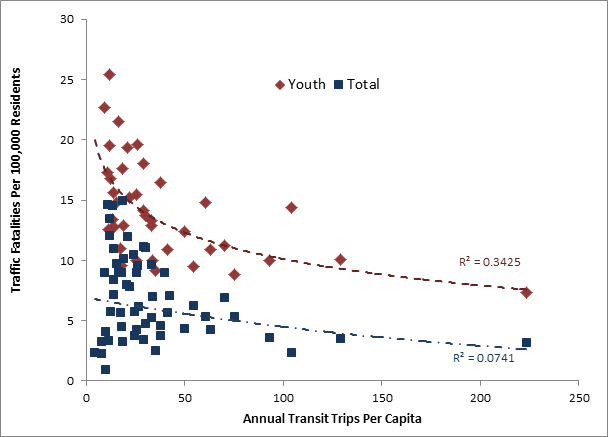
Both youth (15-25 years old) and total traffic fatality rated decline significantly with increased transit travel. The statistical relationship between transit ridership and traffic safety is particularly strong for youths, suggesting that many young people are willing to reduce their higher-risk driving if given suitable alternatives.
This and other research discussed in my article indicate a strong negative relationship between transit ridership and crash fatality rates. This relationship is particularly strong for youths, indicating that many young people want to reduce their driving, but can only do so if given suitable alternatives. This suggests that traffic safety programs which attempt to discourage high risk driving, such as graduated licensing, senior drivers' skill testing, and anti-drunk-driving campaigns, will be much more successful if higher-risk travelers, such as youths, seniors, and drunks, have good alternatives to driving.
These reductions in higher-risk driving benefit everybody, including low-risk drivers, who face less chance of being involved in a crash caused by other drivers' errors. The figure below summarizes the various ways that transit improvements and transit-oriented development increase traffic safety. This helps explain why apparently small increases in public transit ridership can provide large traffic safety benefits.
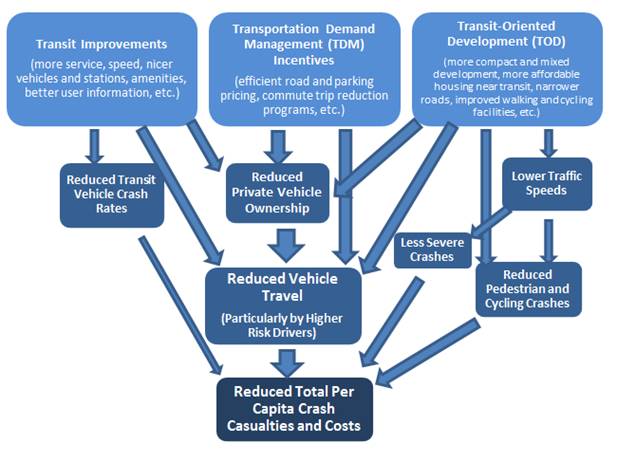
Pro-transit can increase traffic safety in various ways. Some transit improvements reduce transit user risks. Shifting travel from automobile to transit tends to reduce risk to the people who shift and, by reducing total vehicle travel, to reduce risks to other road users. Vehicle travel reductions can also provide significant co-benefits, including reduced traffic and parking congestion, consumer savings, energy conservation, emission reductions, and improved mobility for non-drivers.
Unfortunately, few traffic safety programs recognize these factors. They give little or no consideration to transportation policy reforms that improve travel options and smart growth policies that help reduce per capita vehicle travel, although these can provide large crash reductions in addition to other economic, social and environmental benefits. We need a new narrative concerning public transit safety and the role it should play in traffic safety programs.


Yes, another thing that car dependency makes worse: DUIs
In the land of the free (and the cars), design incites drinking and driving.
September Must-Reads: Top 10 Articles From Last Month
EV drivers can no longer use carpool lanes alone, Bay Area transit is saved — for now — by a $750 million loan, and a Florida commuter rail line loses its state subsidy, jeopardizing its future.
How Complete Streets Stands to Lose in the FY26 ‘Skinny Budget’
The President’s proposed budget could cut key resources for active transportation, public transit, and road safety programs.

The state-sanctioned urbicide of Austin
People don’t kill cities. Freeways do.

US to reduce Colorado River water deliveries to Mexico
A new Colorado Treaty amendment reduces Mexico’s Colorado River water allocation by 250,000 acre feet.

New Jersey’s second-largest city bans standalone data centers
Jersey City will continue to allow co-location facilities, such as those meant for research institutions that store their own data.

Amtrak not solely to blame for New Jersey commuter rail's unreliability, report finds
A new study from the Garden State Initiative found that NJ Transit’s budget grew 20% across a 4 year period, but reliability declined significantly over the same period.

EPA erases limits on planet-warming pollution from power plants
Under Monday’s plan, power plants would still have some limits on how much mercury, arsenic and other contaminants they can emit.

Phoenix announces new on-demand transit service, more frequent RAPID buses
Both new services will launch in October, and are part of Phoenix's Project Effective Access Solutions for Easing Congestion.

FREE Course: Walkable City 1: Why Walkability?
After describing his path towards focusing on walkability as the essence of good planning, Jeff Speck marches through his five principal reasons for making more walkable places.
Reinventing Malls: Planning Alchemy—Turning Gray Fields Into Gold
The course focuses on the opportunities and imperatives that shape reinvention of mall sites.

Eagle County Government
Harvard University Graduate School of Design
Nashville Planning Department
The Architects Foundation
University of Cincinnati Online
The Pocatello Development Authority
The Urban Renewal Agency of the City of Pocatello
Journal of the American Planning Association

