Potentially the biggest culinary innovation since the gourmet food truck, L.A. Prep upholds principles of smart growth while supporting culinary entrepreneurs. Artisanal food producers will move into its 50 kitchens starting in January.


"Just as Los Angeles has a reputation for food deserts, the city as a whole is something of an entrepreneurial desert for artisanal food producers like Ferrazzani. As is the case in inspection-conscious cities around the U.S., the L.A. County Department of Public Health essentially requires all but the smallest-scale producers to work out of restaurant-style kitchens that meet strict heath codes. Those who wish to expand must either invest hundreds of thousands of dollars in their own kitchens, or they turn into “gray market” operators, borrowing restaurant space in the dead of night."
"L.A. Prep is hoping to help these food entrepreneurs compete, if not with Kraft and Nabisco, then at least with Amy’s and Annie’s. Set to open next month in a 56,000-square-foot former warehouse, L.A. Prep will have 50 fully licensed, professional kitchens; it’s basically co-working for cooks."
“I’m passionate about experimentation and innovation in cities,” says Smith. “Everything I’ve done is about opening up the marketplace at the entry level … making it easier for small businesses to do their thing, innovate and realize that awesomeness that is implicit in L.A.”
Read the full story: New L.A. Kitchen Co-Working Space Is Good for Chefs, Foodies and Even the Health Department


Making economic sense of city-owned grocery stores
Several cities are moving to create municipal stores, but do they actually save low-income households money?

'Food Deserts' May Not Be Biggest Factor in Nutrition Discrepancies
According to one recent study, regional culture plays a major part in how healthily people eat. Supply may be less of a factor than demand.
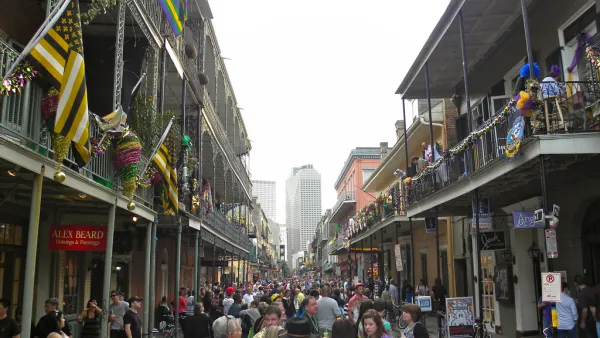
New Orleans Public Markets Make a Comeback
Plagued by supermarket chains and natural disasters, the public markets of New Orleans could help revive community identity. Here are some of the ways they're getting back in business.

Planetizen Federal Action Tracker
A weekly monitor of how Trump’s orders and actions are impacting planners and planning in America.

Amtrak, CN end decades-long dispute with eight-year agreement
The new operating agreement establishes an updated framework for the companies to work together, including processes to resolve disputes.

Judges permit Denver to divert 77,000 acre feet from the Colorado River for reservoir expansion
Overuse and climate change have caused the Colorado River’s water levels to plummet.

Boston has spent millions making the Green Line more accessible — and there’s no end in sight
While the city has invested millions into expanding and adding platforms to the Green Line to make it more accessible, new train cars set to arrive next year will be too tall for disabled passengers to board without raising the current platforms.

Idaho may see an 18% drop in federal surface transit funding — the largest estimated cut in the US
Transit systems in rural communities are much more reliant on federal funding to provide their services.

How ‘post-disaster gentrification’ alters neighborhoods after natural calamities
After hurricanes, fires or other calamities, the original residents of a community are often replaced by younger, wealthier residents.

FREE Course: Walkable City 1: Why Walkability?
After describing his path towards focusing on walkability as the essence of good planning, Jeff Speck marches through his five principal reasons for making more walkable places.
Reinventing Malls: Planning Alchemy—Turning Gray Fields Into Gold
The course focuses on the opportunities and imperatives that shape reinvention of mall sites.

Harvard University Graduate School of Design
KFH Group Inc.
Greater Baltimore Committee
The Architects Foundation
University of Cincinnati Online
The Pocatello Development Authority
The Urban Renewal Agency of the City of Pocatello