Columbus is considering an investment to expand CoGo, its bikeshare system. After a year-and-a-half of operation with public support, CoGo is a model of bikeshare success.


"City Council will consider a proposal Monday to add eight docking stations and 80 bicycles to the bike-sharing system, mostly northward toward Ohio State University," according to Evan Weese. Currently the CoGo system has 30 stations and 300 bikes.
A list of expansion sites is still under consideration (a map of the proposed sites is available here [pdf]). CoGo has performed well after its initial investment of public funding. "The expansion would cost the city $201,450 from a Recreation and Parks bond fund. CoGo is now self-sustaining, [Columbus Recreation and Parks Director Alan] McKnight said, after Columbus provided a subsidy for its first year with an initial $2.2 million investment. It generated 50,000 rides from in [sic] its first year through July." The CoGo bikeshare system opened in July 2013.
FULL STORY: CoGo expansion may take bikes toward OSU, Franklinton and Bexley

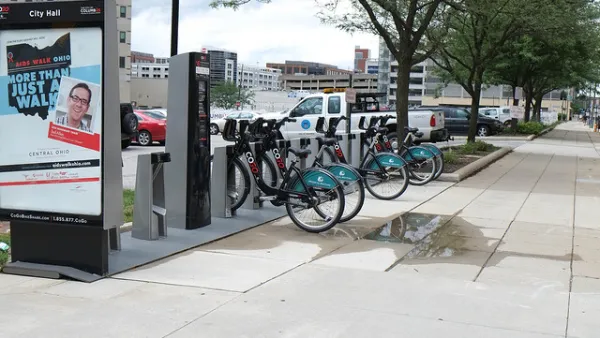
Bikeshare in Columbus on a Roll
After launching in 2013, the bikeshare system in Columbus, called, CoGo, has expanded facilities and increased ridership. Profitability is expected soon, too.
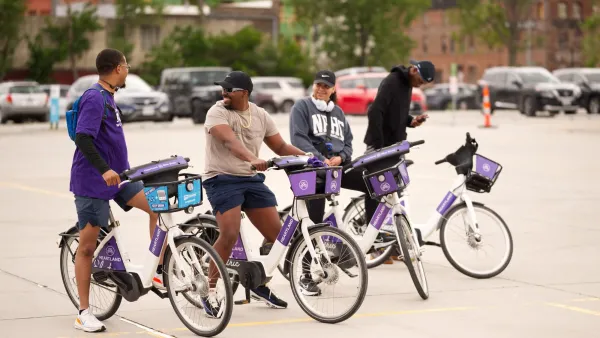
Omaha's 400 shared e-bikes are now free to all residents
Before eliminating fares for locals, the Heartland system only recovered 10%-15% of its operating costs through fare revenue.

Chicago to Add or Upgrade 200 Bike Share Stations
The Divvy bike share system saw its highest ridership ever in 2025 with 6.8 million trips.

Planetizen Federal Action Tracker
A weekly monitor of how Trump’s orders and actions are impacting planners and planning in America.

The state-sanctioned urbicide of Austin
People don’t kill cities. Freeways do.

US to reduce Colorado River water deliveries to Mexico
A new Colorado Treaty amendment reduces Mexico’s Colorado River water allocation by 250,000 acre feet.

LA Metro’s ultimatum: no extra buses for LA28 if federal funding isn’t imminently secured
If Metro does not provide additional buses, LA28 organizers will have to find a new way to manage Olympic traffic. LA28’s budget does not include a line item for transit.

Colorado’s Largest Data Center Could Rise Next to Homes — Without a Public Hearing
The proposed campus would consume 11 times the power of Denver International Airport; as it has across the country, opposition mounts.

5 New England states march closer to 800 megawatt wind energy project
Securing federal approval for the project may be complicated under the Trump administration, which has historically been hostile towards domestic wind power.

FREE Course: Walkable City 1: Why Walkability?
After describing his path towards focusing on walkability as the essence of good planning, Jeff Speck marches through his five principal reasons for making more walkable places.
Reinventing Malls: Planning Alchemy—Turning Gray Fields Into Gold
The course focuses on the opportunities and imperatives that shape reinvention of mall sites.

Eagle County Government
Harvard University Graduate School of Design
Nashville Planning Department
The Architects Foundation
University of Cincinnati Online
The Pocatello Development Authority
The Urban Renewal Agency of the City of Pocatello
Journal of the American Planning Association