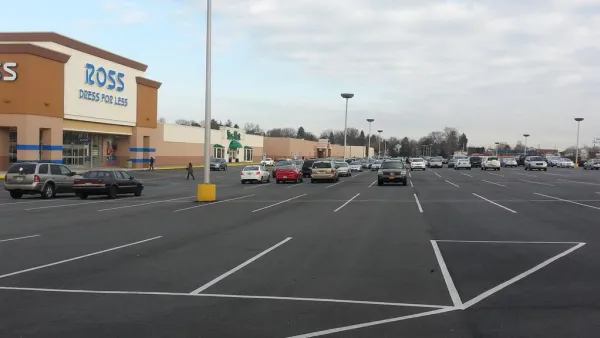
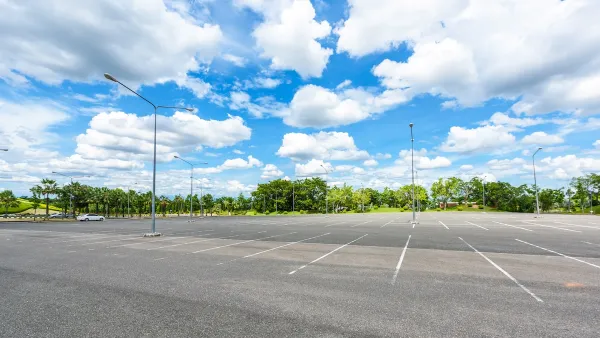
In the most recent iteration of the annual event, social media users around the country submitted images of empty parking lots in front of retail centers on the busiest shopping day of the year.


Charles Marohn once again spearheaded a crowdsourcing exercise known as #blackfridayparking, asking readers to take pictures of underutilized parking lots on the nation's most hallowed shopping day of the year. Marohn's #blackfridayparking
post includes a map of the crowdsourced images and access to the discussion on Twitter.
Writing for Streetsblog, Angie Schmitt also broadcast news of #blackfridayparking, explaining the need for the public shaming of parking lots: "If there’s one thing American planners fear, it’s that someone, sometime, somewhere, won’t be able to immediately find a parking space. Gigantic manuals have been devoted to avoiding this “problem,” and laws have been passed in nearly every community in the nation to ensure that no one ever lacks for parking."
Marohn also held a #blackfridayparking event in 2013, noting at the time that all cities need to do to correct the problem of overabundant parking is to repeal parking minimums.
FULL STORY: #BLACKFRIDAYPARKING

Exposing Black Friday's Parking Perversion
Parking lots across the U.S. are designed to accommodate the crowds of cars participating in the busiest shopping day of the year. By asking his readers to capture images of underutilized lots last Friday, Chuck Marohn set out to expose the fallacy.
Reducing Parking Requirements for Huge, Regional Malls
Fairfax County, Virginia is considering a change to its parking requirements that would lower the number of parking spots at large malls like Tysons Corner Center and Tysons Galleria.
Parking Reform Yields New Housing
As more cities eliminate or reduce their minimum parking requirements, the impact on housing supply is coming into focus.

Planetizen Federal Action Tracker
A weekly monitor of how Trump’s orders and actions are impacting planners and planning in America.

The state-sanctioned urbicide of Austin
People don’t kill cities. Freeways do.

US to reduce Colorado River water deliveries to Mexico
A new Colorado Treaty amendment reduces Mexico’s Colorado River water allocation by 250,000 acre feet.

LA Metro’s ultimatum: no extra buses for LA28 if federal funding isn’t imminently secured
If Metro does not provide additional buses, LA28 organizers will have to find a new way to manage Olympic traffic. LA28’s budget does not include a line item for transit.

Colorado’s Largest Data Center Could Rise Next to Homes — Without a Public Hearing
The proposed campus would consume 11 times the power of Denver International Airport; as it has across the country, opposition mounts.

5 New England states march closer to 800 megawatt wind energy project
Securing federal approval for the project may be complicated under the Trump administration, which has historically been hostile towards domestic wind power.

FREE Course: Walkable City 1: Why Walkability?
After describing his path towards focusing on walkability as the essence of good planning, Jeff Speck marches through his five principal reasons for making more walkable places.
Reinventing Malls: Planning Alchemy—Turning Gray Fields Into Gold
The course focuses on the opportunities and imperatives that shape reinvention of mall sites.

Eagle County Government
Harvard University Graduate School of Design
Nashville Planning Department
The Architects Foundation
University of Cincinnati Online
The Pocatello Development Authority
The Urban Renewal Agency of the City of Pocatello
Journal of the American Planning Association