Parking lots across the U.S. are designed to accommodate the crowds of cars participating in the busiest shopping day of the year. By asking his readers to capture images of underutilized lots last Friday, Chuck Marohn set out to expose the fallacy.


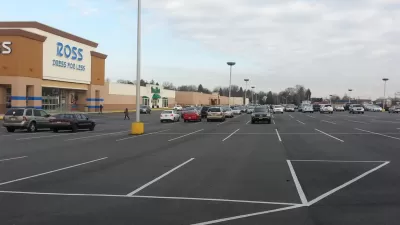
Marohn's inaugural #BlackFridayParking social media campaign was a tremendous success, with dozens of contributors helping to expose the "ridiculous" policies that mandate the oceans of overbuilt parking that blight our landscapes.
"Can you imagine Wal-Mart building an entire row of their store and then leaving the shelves empty? It would be ridiculous. Why then do we simply accept that large swaths of their land would be built upon for a use (parking) that literally never happens? We accept it because that is the price of entry, the cost of complying with local regulations," he writes.
"Here's the great thing: the solution to this problem is really, really easy. All a city needs to do is repeal their parking minimums. If you want to stop this ridiculous waste of resources, support small businesses, encourage reuse of existing properties, limit environmental degradation and make your city financially stronger, just repeal your minimum parking requirement. No lawyer or expensive consultant is necessary."
Read the full story: The meaning of #BlackFridayParking

#BlackFridayParking Exposes that Empty Feeling
In the most recent iteration of the annual event, social media users around the country submitted images of empty parking lots in front of retail centers on the busiest shopping day of the year.

Reducing Parking Requirements for Huge, Regional Malls
Fairfax County, Virginia is considering a change to its parking requirements that would lower the number of parking spots at large malls like Tysons Corner Center and Tysons Galleria.
Parking Reform Yields New Housing
As more cities eliminate or reduce their minimum parking requirements, the impact on housing supply is coming into focus.

Planetizen Federal Action Tracker
A weekly monitor of how Trump’s orders and actions are impacting planners and planning in America.

‘Going backwards:’ Baltimore mayor, students rally against state's transit funding plan
Maryland's proposed six-year plan provides no funding for Baltimore’s BMORE bus program and reduces its road maintenance funding.

Detroit to transform waterfront with $2.2 billion investment
Developers will convert about 18 acres of unused parking lot space into civic spaces.

U.S.-Iran war may have ‘devastating’ impact on cost to warm homes
Vermont and Maine residents may see a 76% increase in the cost of warming their homes this winter.

Senate bill would ‘overhaul’ environmental permitting laws
Under the proposed act, government agencies would also not be able to suspend or rescind permits after granting them.

Exemption applications for NYC’s pied-à-terre tax see 55% success rate
The city sent nearly 40% of its initial pied-à-terre tax warnings erroneously.

FREE Course: Walkable City 1: Why Walkability?
After describing his path towards focusing on walkability as the essence of good planning, Jeff Speck marches through his five principal reasons for making more walkable places.
Reinventing Malls: Planning Alchemy—Turning Gray Fields Into Gold
The course focuses on the opportunities and imperatives that shape reinvention of mall sites.

One Hundred Miles
County of Mendocino
planning NEXT
The Architects Foundation
University of Cincinnati Online
Montrose County
Northern Illinois Transit Authority (NITA)
The Pocatello Development Authority