A new Dutch invention uses lasers to scare birds away, intended to mitigate their interference with critical industries.


As discussed on Co.Exist by Ben Schiller, birds pose a problem for many industries—they get caught in aircraft engines and wind turbines, eat farmers’ crops, and frustrate greenskeepers. 23-year old Dutch entrepreneur Steinar Henskes developed diffused laser beams intended to scare these birds away from any given location.
Aerolaser, as the product is called, uses "a green, filtered light that reduces radiation. When birds see it, they think of it as a physical danger and immediately scatter..."
For an example of a sector that could use the technological help: "The Federal Aviation Association spends hundreds of millions of dollars a year to keep our feathered friends away from flightpaths... New York's JFK Airport, for instance, has about a dozen full-time bird control staff."
So far, Aerolaser has been sold in 46 different places, including the United States of America and many European countries.
Read the full story: Keeping Birds Away From Runways, Oil Rigs, And Agriculture With Laser Beams


Protecting Birds From Window Glass
Glass windows kill billions of birds each year. Simple fixes can help.

Embracing Spring: Ways to Reconnect With Nature and Find Joy
This spring, reconnect with nature and enhance your well-being through simple activities like observing plants up close, practicing forest bathing, birdwatching, arranging flowers, and starting a container garden.
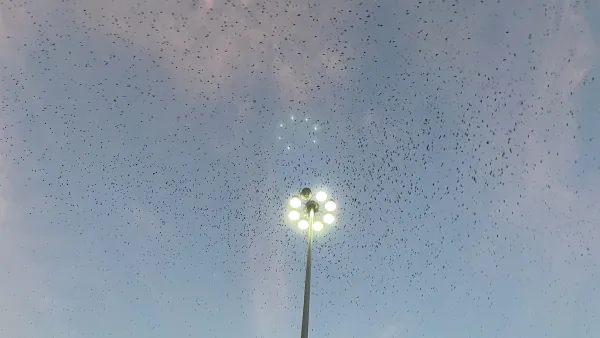
Purple Martins Call Nashville Home. Some Wish They Wouldn't
Each year, the city plays host to hundreds of thousands of birds on their way to and from South America.

Planetizen Federal Action Tracker
A weekly monitor of how Trump’s orders and actions are impacting planners and planning in America.

Amtrak, CN end decades-long dispute with eight-year agreement
The new operating agreement establishes an updated framework for the companies to work together, including processes to resolve disputes.

Judges permit Denver to divert 77,000 acre feet from the Colorado River for reservoir expansion
Overuse and climate change have caused the Colorado River’s water levels to plummet.

NYC DOT wants faster, more permanent street upgrades
The city is examining ways to build more concrete infrastructure without getting entangled in 'decades-long' projects.

'Something we’ve never seen before:' rising utility rates could strain city finances nationwide
Data centers, climate change and other factors have caused utility rates in the United States to increase by 38% since 2020.

Trump to overrule local leaders, lease millions of acres of America’s Pacific Island territories’ seafloors to mining companies
International law says that the Indigenous people of America’s territories have a right to prior and informed consent regarding projects that impact their countries.

FREE Course: Walkable City 1: Why Walkability?
After describing his path towards focusing on walkability as the essence of good planning, Jeff Speck marches through his five principal reasons for making more walkable places.
Reinventing Malls: Planning Alchemy—Turning Gray Fields Into Gold
The course focuses on the opportunities and imperatives that shape reinvention of mall sites.

Harvard University Graduate School of Design
KFH Group Inc.
Greater Baltimore Committee
The Architects Foundation
University of Cincinnati Online
The Pocatello Development Authority
The Urban Renewal Agency of the City of Pocatello