A new report sheds light on the income gap in the use of bikeshare systems around the world.


Eric Jaffe delves into the findings of a report by the Mineta Transportation Institute regarding the growth of bikeshare systems in the United States. The report, "Public Bikesharing in North America During a Period of Rapid Expansion: Understanding Business Models, Industry Trends and User Impacts [pdf]," includes data revealing the systemic challenge of delivering bikeshare to low income populations.
After showing some of the income disparities found in systems like those in the Twin Cities, Salt lake City, Toronto, and Mexico City, Jaffe shares a point made in the report: "Many systems don't make much of an effort to place bike-share stations in low-income neighborhoods. Only nine of 21 selected systems interviewed by the report authors said equity factored into station location. The business end of bike-share potentially plays a major role here: Tourist locations tend to generate the most membership and the most revenue..."
Jaffe notes that a new system expected to launch next spring in Philadelphia will deliberately target low income neighborhoods for stations, providing a model of equity-based planning for bikeshare systems around the country (and world).
Read the full story: Bike-Share Is (Still) Struggling to Reach Poor People Across North America

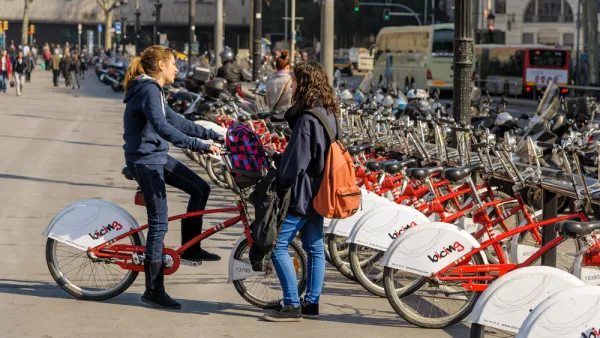
Report: Bikeshare Makes Biking Safer
In the United States, not a single bikeshare rider has died in an accident so far. A report from the Mineta Transportation Institute considers why bikeshare may be safer than conventional biking.
More Evidence That Bikeshare Systems Are the Safest Way to Bike
Another study from a reputable think-tank offers evidence that bikeshare is the safest way to bike.
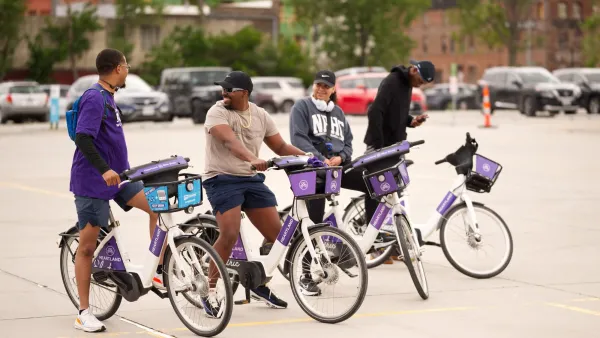
Omaha's 400 shared e-bikes are now free to all residents
Before eliminating fares for locals, the Heartland system only recovered 10%-15% of its operating costs through fare revenue.

Planetizen Federal Action Tracker
A weekly monitor of how Trump’s orders and actions are impacting planners and planning in America.

Amtrak, CN end decades-long dispute with eight-year agreement
The new operating agreement establishes an updated framework for the companies to work together, including processes to resolve disputes.

Judges permit Denver to divert 77,000 acre feet from the Colorado River for reservoir expansion
Overuse and climate change have caused the Colorado River’s water levels to plummet.

NYC DOT wants faster, more permanent street upgrades
The city is examining ways to build more concrete infrastructure without getting entangled in 'decades-long' projects.

'Something we’ve never seen before:' rising utility rates could strain city finances nationwide
Data centers, climate change and other factors have caused utility rates in the United States to increase by 38% since 2020.

Trump to overrule local leaders, lease millions of acres of America’s Pacific Island territories’ seafloors to mining companies
International law says that the Indigenous people of America’s territories have a right to prior and informed consent regarding projects that impact their countries.

FREE Course: Walkable City 1: Why Walkability?
After describing his path towards focusing on walkability as the essence of good planning, Jeff Speck marches through his five principal reasons for making more walkable places.
Reinventing Malls: Planning Alchemy—Turning Gray Fields Into Gold
The course focuses on the opportunities and imperatives that shape reinvention of mall sites.

Harvard University Graduate School of Design
KFH Group Inc.
Greater Baltimore Committee
The Architects Foundation
University of Cincinnati Online
The Pocatello Development Authority
The Urban Renewal Agency of the City of Pocatello