Philadelphia City Council President Darrell Clarke will release the details of a proposal to consolidate planning and development approval authority into a new, cabinet-level city department.


"City Council President Darrell L. Clarke says he will lay out a proposal Thursday to radically restructure how the city manages planning, development and construction in Philadelphia," reports Chris Hepp. A few key organizing principles of what is, in effect, a consolidation plan, as described by Hepp:
- "His proposal calls for a City Charter amendment to create a cabinet-level Department of Planning and Development that would oversee and coordinate functions now handled by seven unrelated agencies, boards and commissions, including the Planning Commission, the Historical Commission, the Department of Licenses and Inspections, and the Housing Authority."
- "Under Clarke's proposal, a Department of Planning and Development would have three divisions: planning and zoning; licenses, inspections, and enforcement; and housing."
The proposal would require City Council approval and a voter referendum.
Read the full story: Amid L&I overhaul talk, Clarke offering plan to restructure Phila. agencies
Proposed Planning and Development Reorganization Stalls in Philadelphia
A drastic overhaul of the planning and development processes in Philadelphia is, at least for now, on hold so stakeholders can have more time to analyze the proposal.
Government Reform Proposed for Better Planning in Philadelphia
Geoff Kees Thompson digs into one component of this old city's proposed mayoral platform for Philadelphia: the need to organize the city's alphabet soup of planning agencies under one director and give the Planning Commission teeth.
Neighborhood Rezoning Proposal at Odds With Philadelphia's Comprehensive Plan
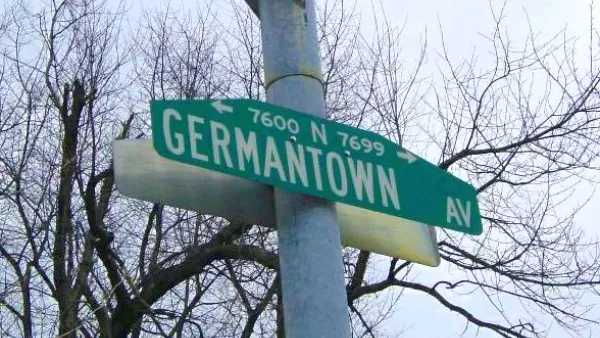
While planning departments around the country make news for removing exclusionary zoning and parking requirements, many neighborhoods still show a strong preference for parking minimums and development limits. Case in point: Germantown, Philadelphia.

Planetizen Federal Action Tracker
A weekly monitor of how Trump’s orders and actions are impacting planners and planning in America.

California plans to bury El Niño’s downpour
If the state plays its cards right, it may be able to store a billion acre-feet of El Niño’s water in aquifers.

Desperate measures: Advocates weigh draining Lake Powell to fill Colorado River
Draining the reservoir could reduce evaporation losses by a couple hundred thousand acre-feet.

Mamdani’s pied-à-terre tax survives legal challenge
A panel of judges found that the plaintiffs failed to demonstrate injury as a result of New York City's implementation of the tax.

Eastern Nebraska is running out of electricity
Data centers and electrification are straining eastern Nebraska’s grid, throttling economic development.

Seattle passes record-breaking transit services expansion
Proposition 1 will double the city’s transit tax to add 95,000 more bus trips and preserve 180,000 bus trips annually.

FREE Course: Walkable City 1: Why Walkability?
After describing his path towards focusing on walkability as the essence of good planning, Jeff Speck marches through his five principal reasons for making more walkable places.
Reinventing Malls: Planning Alchemy—Turning Gray Fields Into Gold
The course focuses on the opportunities and imperatives that shape reinvention of mall sites.

City of Rosemead
Rutgers University, Edward J. Bloustein School of Planning and Public Policy
One Hundred Miles
University of Michigan School for Environment and Sustainability (SEAS)
Hunter College, City University of New York (CUNY)
The Architects Foundation
City of Cambridge
Montrose County
The Pocatello Development Authority