A public-private partnership will create the "Louisville Food Hub" in the West End neighborhood. Mayor Greg Fischer suggested that the hub might be more critical to the revitalization of the neighborhood than a proposed Wal-Mart.


"In a move to strengthen the production and distribution of locally grown food in Louisville, Mayor Greg Fischer this week granted a 24-acre vacant parcel of land in the West End worth $1.2 million to developers of a 'Louisville Food Hub,'" reports Jere Downs and Sheldon S. Shafer.
"Seed Capital Kentucky, the hub's nonprofit developer, is pursuing tax credits to fund a warehouse, commercial kitchen and office space. It is negotiating final details with food and agriculture-related companies, including a juicery, an industrial food processor and a 2-acre demonstration farm. The first company to break ground later this year is a privately funded $20 million methane gas plant powered by compost and staffed by 21 union workers."
Read the full story: Food hub 'job-generating machine' for West End

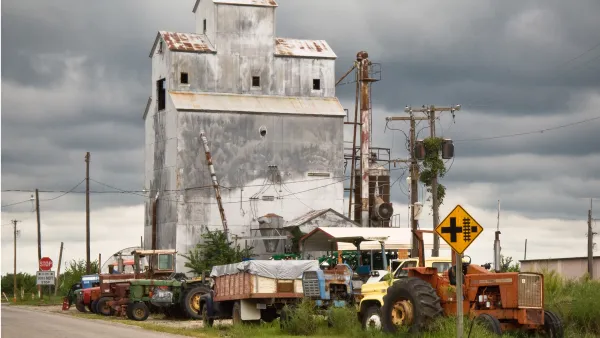
Louisville Builds Food Hub 2.0
Unlike conventional food hubs, Louisville's planned $50 million FoodPort will gather and 'incubate' regional food businesses. The hope is to breathe life into the area's struggling small farms.
Louisville Creates its First Municipal DOT
The new department will be tasked with speeding up transportation and infrastructure projects.
Louisville Begins Process to Clean Superfund Site
A public forest is home to dozens of barrels that have been leaking toxic materials for decades.

Planetizen Federal Action Tracker
A weekly monitor of how Trump’s orders and actions are impacting planners and planning in America.

Amtrak, CN end decades-long dispute with eight-year agreement
The new operating agreement establishes an updated framework for the companies to work together, including processes to resolve disputes.

Judges permit Denver to divert 77,000 acre feet from the Colorado River for reservoir expansion
Overuse and climate change have caused the Colorado River’s water levels to plummet.

How ‘post-disaster gentrification’ alters neighborhoods after natural calamities
After hurricanes, fires or other calamities, the original residents of a community are often replaced by younger, wealthier residents.

Maryland local governments examine if they should have more power to raise property taxes
Maryland’s housing market is out of reach for the majority of moderate-income residents.

Northwest rail fans eager for Sept. 30 debut of Amtrak’s Airo fleet
Get ready for that new train smell and more seats. But they won’t go faster or run more frequently on the Cascades route in Washington and Oregon.

FREE Course: Walkable City 1: Why Walkability?
After describing his path towards focusing on walkability as the essence of good planning, Jeff Speck marches through his five principal reasons for making more walkable places.
Reinventing Malls: Planning Alchemy—Turning Gray Fields Into Gold
The course focuses on the opportunities and imperatives that shape reinvention of mall sites.

Harvard University Graduate School of Design
KFH Group Inc.
Greater Baltimore Committee
The Architects Foundation
University of Cincinnati Online
The Pocatello Development Authority
The Urban Renewal Agency of the City of Pocatello