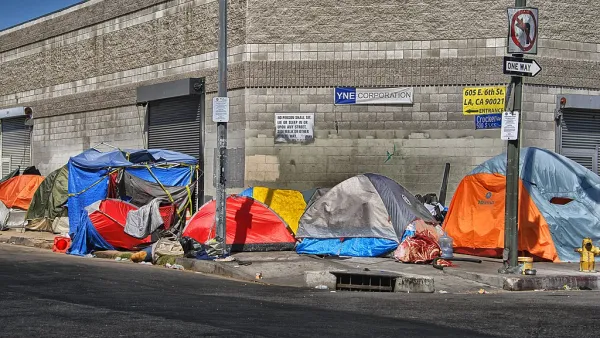
Broadening a system first tested in Los Angeles in 2013, a coalition of local and national government agencies and philanthropic organizations has provided $213 million for the Home for Good program—described as "match.com for homeless people."


"A coalition of public and private agencies announced Tuesday that it is funneling $213 million to house 1,400 homeless people and to expand a tracking and placement system it hopes will end chronic and veteran homelessness in Los Angeles County over the next two years," reports Gale Holland.
"The placement tool, called the coordinated entry system, is designed to replace a confusing patchwork of entry points to homeless housing and services with a single computerized portal that reaches every corner of the county."
Once in the coordinated entry system, the participants in the program will receive permanent housing and long-term support: "The 1,400 units of permanent supportive housing will include medical and psychiatric services for residents for 15 years."
Read the full story: $213 million earmarked to track L.A. homeless by computer, house 1,400


Trump's promise to house 6,000 homeless veterans on a Los Angeles VA campus missing from budget proposal
The president's proposed budget fails to include any funding for the proposed 'Center for Warrior Independence.'
Homelessness Fuels a Backlash in California
The Golden State's ongoing homelessness crisis has residents on edge and is testing the limits of empathy in a state known for its liberal values.

Will Appeal of Landmark Appeals Court Ruling Allow for Clearing of Tent Cities?
If the Supreme Court hears an appeal of a landmark U.S. Ninth Circuit Court case settled in April, the ruling would have widespread implications for dealing with homeless encampments throughout the West, perhaps nowhere more so than Los Angeles.

Planetizen Federal Action Tracker
A weekly monitor of how Trump’s orders and actions are impacting planners and planning in America.

Amtrak, CN end decades-long dispute with eight-year agreement
The new operating agreement establishes an updated framework for the companies to work together, including processes to resolve disputes.

Northwest rail fans eager for Sept. 30 debut of Amtrak’s Airo fleet
Get ready for that new train smell and more seats. But they won’t go faster or run more frequently on the Cascades route in Washington and Oregon.

Brightline Florida files for bankruptcy
The transit company is over $5 billion in debt.

St. Louis Metro to test if single-car trains can reduce operating costs, maintain rider satisfaction
The pilot program will run from October to spring 2027, and begin with one single-car train operating on Metrolink’s Red and Blue lines.

Pennsylvania is building data centers in abandoned mines
Housing data centers in mines provides an alternative to destroying local forests and may spare residents from data centers’ noise and air pollution.

FREE Course: Walkable City 1: Why Walkability?
After describing his path towards focusing on walkability as the essence of good planning, Jeff Speck marches through his five principal reasons for making more walkable places.
Reinventing Malls: Planning Alchemy—Turning Gray Fields Into Gold
The course focuses on the opportunities and imperatives that shape reinvention of mall sites.

City of Thousand Oaks
City of Wisconsin Rapids
Harvard University Graduate School of Design
The Architects Foundation
University of Cincinnati Online
The Pocatello Development Authority
The Urban Renewal Agency of the City of Pocatello