With so many eyes trained obsessively on mobile phones, the outdoor industry is supporting a campaign to place famous art on billboards around the country. Will people notice? Should they?


The Dallas Museum of Art, the Art Institute of Chicago, the Los Angeles County Museum of Art, the National Gallery of Art in Washington, D.C., and the Whitney Museum of American Art in New York recently partnered to spearhead a campaign called Art Everywhere, in which master works of American art are placed on billboards around the country.
Setting aside the ostensible purpose of reclaiming these public displays for highbrow expressions of creativity rather than crass marketing campaigns, Paul Hiebert points out the other, less obvious beneficiary of the campaign: the outdoor advertising industry.
According to Hiebert, "the Outdoor Advertising Association of America, a trade group for out-of-home advertisers and an Art Everywhere U.S. collaborator, is hoping the project will get more people looking up and around again instead of down at their digital devices. Major sponsors also include big-name advertisers such as CBS Outdoor, Clear Channel Outdoor, and JCDecaux."
Read the full story: Can Outdoor Art Revitalize Outdoor Advertising?

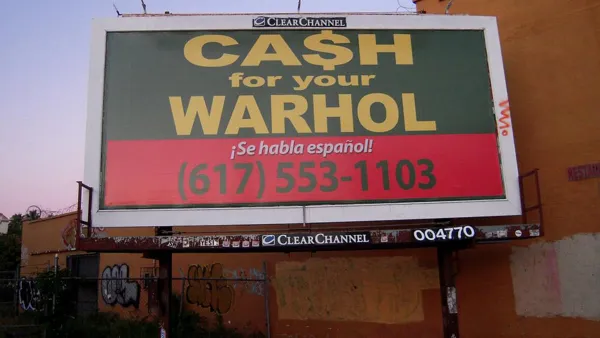
Coming to a Billboard Near You: The 'Art Everywhere' Project
Voting for a new project called "Art Everywhere" is currently open to the public on works from five of the country’s largest and most respected museums. The vote will help decide which images get placed on some 50,000 billboards this summer.
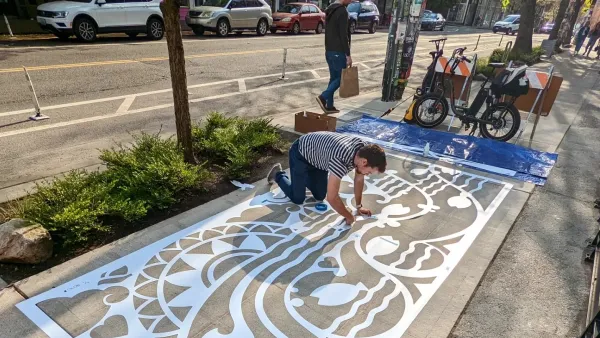
This Seattle sidewalk art only appears when it rains
Prompted to find a silver lining to the gloom of rainy Pacific Northwest days, an artist hit upon a novel solution: water-activated sidewalk paint.
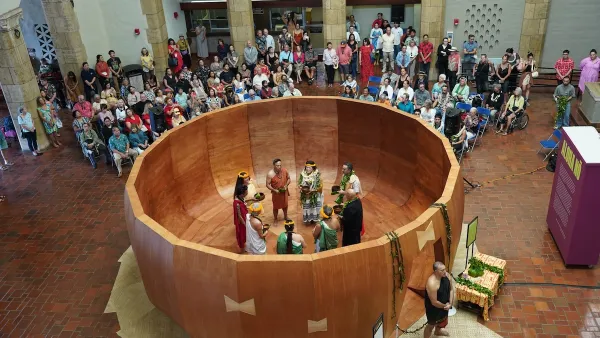
A Monument to Resilience: Native Hawaiian Art Installation Honors History and Healing
The towering ʻUmeke Lāʻau installation by Native Hawaiian artist Meleanna Aluli Meyer, unveiled at Honolulu's city hall, is a powerful symbol of cultural resilience and healing.

Planetizen Federal Action Tracker
A weekly monitor of how Trump’s orders and actions are impacting planners and planning in America.

California plans to bury El Niño’s downpour
If the state plays its cards right, it may be able to store a billion acre-feet of El Niño’s water in aquifers.

Chicago breaks ground on $3 billion megadevelopment
The new neighborhood, titled Foundry Park, will one day host 3,700 residences.

Satanic place names
From streams and lakes to valleys and canyons, I mapped more than 1,000 places named after the Devil.

California High-Speed Rail Authority CEO resigns after $600,000 scandal
Under Ian Choudri, the authority used taxpayer dollars to fund first class flights and trips to nightclubs.

Want to study the Missouri River? Soon, you may need unanimous approval from 10 states
Legislation would require 10 governors’ permission to study or build projects moving water outside the basin.

FREE Course: Walkable City 1: Why Walkability?
After describing his path towards focusing on walkability as the essence of good planning, Jeff Speck marches through his five principal reasons for making more walkable places.
Reinventing Malls: Planning Alchemy—Turning Gray Fields Into Gold
The course focuses on the opportunities and imperatives that shape reinvention of mall sites.

City of Rosemead
Rutgers University, Edward J. Bloustein School of Planning and Public Policy
One Hundred Miles
Hunter College, City University of New York (CUNY)
The Architects Foundation
University of Cincinnati Online
City of Cambridge
Montrose County
The Pocatello Development Authority