A new report by the U.S. Conference of Mayors highlights the growing income divide, breaking the data down to the local level and finding that income inequality grew in two out of three metro areas between 2005 and 2012.


Niraj Chokshi details the new U.S. Metro Economies Report by the U.S. Conference of Mayors, called "Income and Wage Gaps Across the US." According to Chokshi, the report "explores how the Great Recession affected wages and income in hundreds of metropolitan statistical areas — population and economic hubs typically encompassing a large city or cities."
"Among the key findings is that the jobs gained in the recovery paid an average of 23 percent less than those lost," and, moreover, "[income] inequality appears to have grown in more than 2 in 3 metropolitan areas from 2005 to 2012."
The coverage also includes a pair or map visualizations showing the gap between mean and median incomes in 350 metropolitan areas.

Read the full story: Income inequality seems to be rising in more than 2 in 3 metro areas
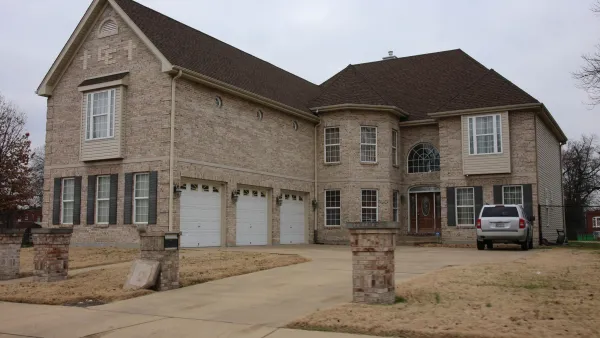
Why the McMansion Isn't Really Back
Joe Cortright criticizes reports linking high median new home sizes to a renewed demand for McMansions. The market for single-family homes, he argues, locks out buyers of modest means. Only the well-off are buying.
Report: Which American Cities Are the Most Unequal
According to Brookings, this research is intended to inform local debates over the minimum wage. Drawing on Census data, the report finds that astronomical income gains are still concentrated among the biggest cities.
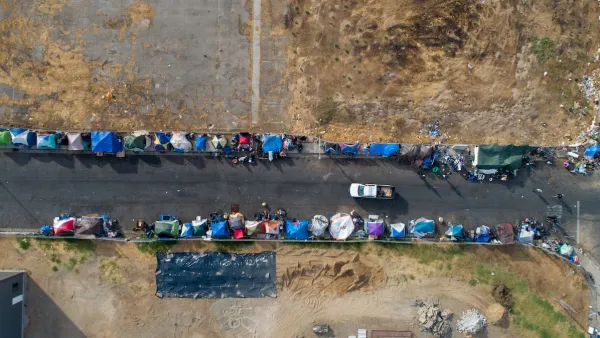
Mayors’ Meeting Focuses on Housing Crisis
As the number of unhoused Americans grows, mayors met to learn from each other and assess their needs for federal support.

Planetizen Federal Action Tracker
A weekly monitor of how Trump’s orders and actions are impacting planners and planning in America.

California plans to bury El Niño’s downpour
If the state plays its cards right, it may be able to store a billion acre-feet of El Niño’s water in aquifers.

Desperate measures: Advocates weigh draining Lake Powell to fill Colorado River
Draining the reservoir could reduce evaporation losses by a couple hundred thousand acre-feet.

In Texas, data centers are swallowing promised parkland
Residents who moved to Taylor, Texas for a rural community now have to contend with three data centers in their backyard.

How a Chicago-sized wind farm beat the odds and powered on
The project spanned five presidential administrations and a standoff with a U.S. military base.

MTA gives itself 30 days to transform pit into basketball court
The site has been under construction since 2022; the city originally estimated it would finish the court in 2024.

FREE Course: Walkable City 1: Why Walkability?
After describing his path towards focusing on walkability as the essence of good planning, Jeff Speck marches through his five principal reasons for making more walkable places.
Reinventing Malls: Planning Alchemy—Turning Gray Fields Into Gold
The course focuses on the opportunities and imperatives that shape reinvention of mall sites.

City of Rosemead
Rutgers University, Edward J. Bloustein School of Planning and Public Policy
One Hundred Miles
Hunter College, City University of New York (CUNY)
The Architects Foundation
University of Cincinnati Online
City of Cambridge
Montrose County
The Pocatello Development Authority