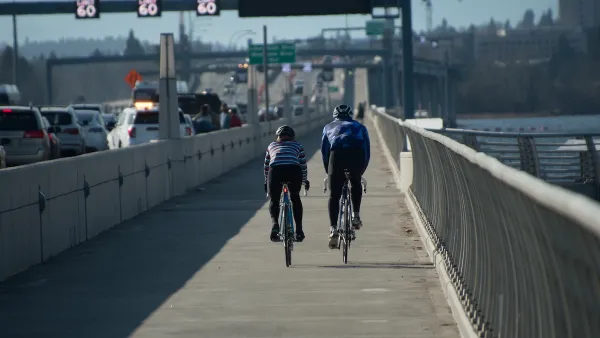
Seattle is hoping to transform the 2nd Avenue bike lane from the cities worst—location of 60 bike collisions in the last four years—to a demonstration of the state-of-the-art in bike infrastructure design.


"The Seattle Department of Transportation released their proposed redesign for 2nd Avenue; a demonstration project that will transform the bike lane from a dangerous one-way bike lane sandwiched between parked cars and traffic to a two-way 'cycle track' with a barrier separating it from traffic and no parking lane to deal with," reports Josh Cohen.
Mayor Ed Murray promised that the lane would be ready in time for the launch of the city's Pronto! bike share program in September.
"According to SDOT, there have been 60 collisions involving bikes in the lane in the past four years — a mix of bicyclists getting doored by people exiting their parked cars, drivers pulling out of the parking lane across the bike lane and, in more than half the cases, bicyclists getting hit in intersections by drivers turning across the bike lane (known as a left hook)."
Read the full story: Facelift for 2nd Avenue's bike death trap
Seattle Adjusts Signals for Downtown Protected Bike Lane
Brandon G. Donnelly reports that after implementing a Downtown protected bike lane along 2nd Avenue, Seattle has had to make some adjustments to the signaling for the lane.
Complete Street Makeover in the Works for 2nd Street in San Francisco
Planners in San Francisco are working on a complete street redo of a key corridor through the SoMa neighborhood that will connect downtown, Mission Bay, and the Central Waterfront.
Seattle Road Safety Advocates Say Transportation Levy Perpetuates Car-Centric Status Quo
Critics of a proposed $1.3 billion transportation levy say the package isn’t enough to keep up with inflation and rising costs and fails to support a shift away from car-oriented infrastructure.

Planetizen Federal Action Tracker
A weekly monitor of how Trump’s orders and actions are impacting planners and planning in America.

California plans to bury El Niño’s downpour
If the state plays its cards right, it may be able to store a billion acre-feet of El Niño’s water in aquifers.

Desperate measures: Advocates weigh draining Lake Powell to fill Colorado River
Draining the reservoir could reduce evaporation losses by a couple hundred thousand acre-feet.

US buildings threatened, destroyed by fires set to triple by 2060
Researchers found a high fire risk for socioeconomically vulnerable neighborhoods in the American West.

LA residents may be allowed to paint their own crosswalks
Councilwoman Katy Yaroslavsky put out a motion instructing the Los Angeles Department of Public Transportation to study the feasibility of allowing volunteers to paint crosswalks.

Dallas moves to overhaul its zoning code
The city's zoning reform will allow more multi-family and mixed-use developments.

FREE Course: Walkable City 1: Why Walkability?
After describing his path towards focusing on walkability as the essence of good planning, Jeff Speck marches through his five principal reasons for making more walkable places.
Reinventing Malls: Planning Alchemy—Turning Gray Fields Into Gold
The course focuses on the opportunities and imperatives that shape reinvention of mall sites.

City of Rosemead
Rutgers University, Edward J. Bloustein School of Planning and Public Policy
One Hundred Miles
Hunter College, City University of New York (CUNY)
The Architects Foundation
University of Cincinnati Online
City of Cambridge
Montrose County
The Pocatello Development Authority