Victoria Dailey has some strong words for the palm tree in its various forms around Los Angeles in a long read for the Los Angeles Review of Books.


A well-crafted paragraph provides entre to Dailey's argument: "Lately, as I have been scanning the local horizon, the pervasive palms have begun to make me feel queasy. In fact, they now irritate me. I long to see a vista uninterrupted by the skinny, merciless palms — they mock the very idea of shade, and in a region with abundant sunshine, their presence is exasperating. Like alien invaders, reckless colonizers, and 'escaped exotics,' as invasive plant species are known, palms have driven out more modest species, claiming, as autocrats do, the exclusive right to reign supreme — they alone signify the arboreal realm of Los Angeles despite their inability to provide shade, their over-reliance on water and their environmental incongruity."
The essay revolves around concepts of piety and perversity—highly recommended reading for landscape architects, historians, and fans of Los Angeles.
Read the full story: Piety and Perversity: The Palms of Los Angeles
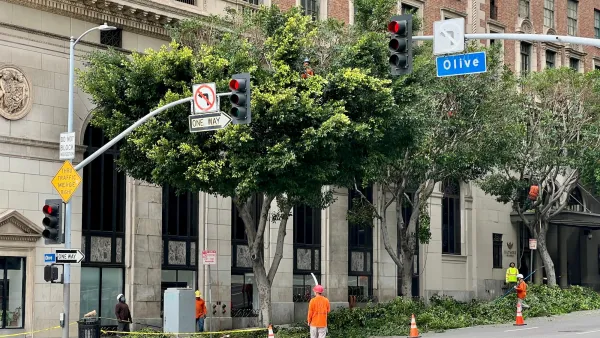
LA’s Tree Canopy is Nearing a ‘Point of Failure’
Calls to 311 for “tree emergencies” are rising, endangering a resource that helps bring down urban temperatures and reduce air pollution.
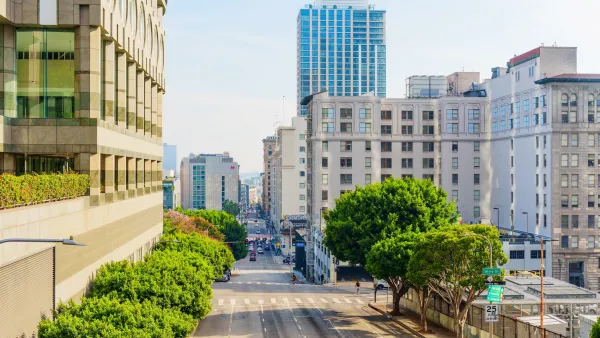
LA’s Tree Emergency Goes Beyond Vandalism
After a vandal destroyed dozens of downtown LA trees, Mayor Karen Bass vowed to replace them. Days later, she slashed the city’s tree budget.
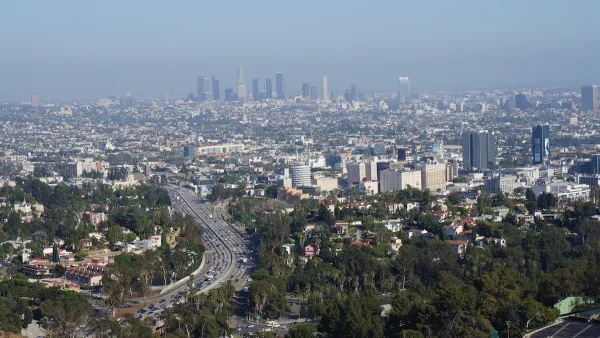
Updating LA’s Tree Rules Could Bring More Shade to Underserved Neighborhoods
A new USC study finds that relaxing Los Angeles’ outdated tree planting guidelines could significantly expand urban tree canopy and reduce shade disparities in lower-income neighborhoods, though infrastructure investments are also needed.

Desperate measures: Advocates weigh draining Lake Powell to fill Colorado River
Draining the reservoir could reduce evaporation losses by a couple hundred thousand acre-feet.

Eastern Nebraska is running out of electricity
Data centers and electrification are straining eastern Nebraska’s grid, throttling economic development.

Malls are becoming the midtowns of the future
Mall and office park redevelopments are a generational opportunity to create new nodes of urbanity.

NYC breaks ground on anti-flooding infrastructure project
New York City's new system will reduce stormwater flows to local sewers by 90%.

One Kentucky town’s secret to affordable housing
The Smoketown Community Land Trust has already built seven affordable homes for community members.

Houston gains petal-shaped cooling infrastructure to make streets more ‘delightful’
The city has installed the pavilions along 15 blocks in Houston.

FREE Course: Walkable City 1: Why Walkability?
After describing his path towards focusing on walkability as the essence of good planning, Jeff Speck marches through his five principal reasons for making more walkable places.
Reinventing Malls: Planning Alchemy—Turning Gray Fields Into Gold
The course focuses on the opportunities and imperatives that shape reinvention of mall sites.

City of Rosemead
Rutgers University, Edward J. Bloustein School of Planning and Public Policy
One Hundred Miles
University of Michigan School for Environment and Sustainability (SEAS)
Hunter College, City University of New York (CUNY)
The Architects Foundation
City of Cambridge
Montrose County
The Pocatello Development Authority