A recently released tool for analyzing the efficiency of travel modes in cities around the country reveals that driving is almost always a better choice—at least in travel time—than transit.


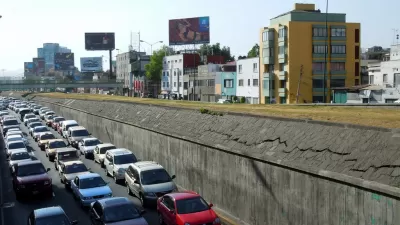
Emily Badger follows up on a set of visualization tools recently released by the MIT Media Lab on the You Are Here website:
"Two things are particularly striking [about the visualizations]: Cycling is a much more efficient mode of transportation than many people realize. And transit is startlingly not so. Seldom will it get you farther, faster, than a bike will." Moreover, "[very] little of the city — just one tiny patch of it — is accessed fastest by transit. This picture would no doubt look different if we removed bikes from the calculation entirely and simply compared cars and transit. But even then, the city would still look more broadly accessible to you from behind the wheel of a car."
As Badger points out, that trend holds true in many of the country's largest cities, and, thus, "these maps illustrate why people make rational calculations to drive so much of the time, even in cities where decent transit does exist."
Badger goes on to cite Manhattan as a model for what it takes to bring the efficiency of transit in line with that of the automobile.
Read the full story: Why cars remain so appealing even in cities with decent public transit

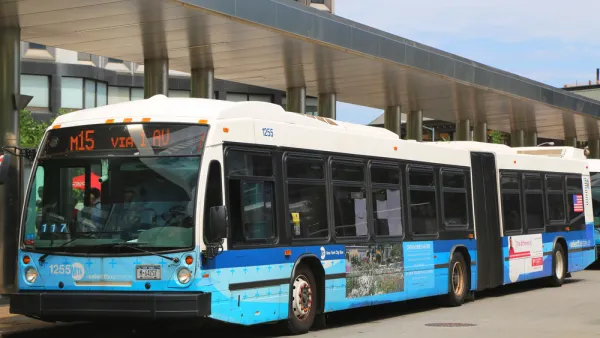
Improved Service Speeds Up Buses, Increases Ridership
The data on select bus service (SBS) in the Metropolitan Transportation Authority bus system are definitive: with off-board payment and bus-only lanes, buses perform better and attract more riders.
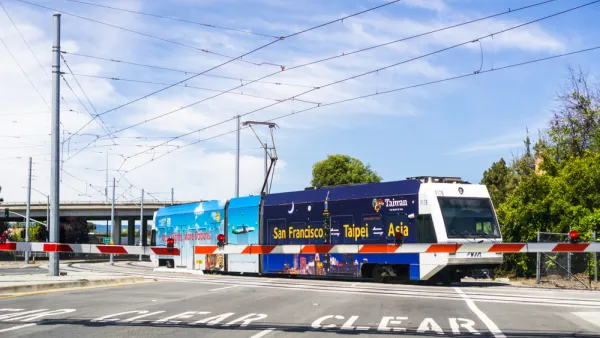
Speeding Up Trains and Improving Traffic Safety in San Jose
At-grade light rail has a hard time safely and efficiently traversing Downtown San Jose on Second Street. A new pilot project will look to improve the situation.
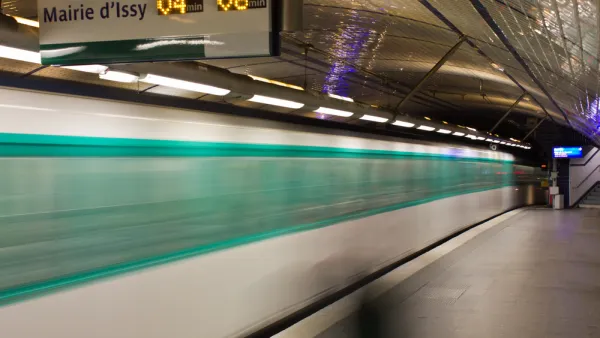
The Value of Fast Transit—Under Construction in Paris
The proposed Grand Paris Express program, which began construction this summer and is expected for completion in 2030, will serve 2 million people a day at "wildly fast speeds." Then there's light rail in the United States.

Planetizen Federal Action Tracker
A weekly monitor of how Trump’s orders and actions are impacting planners and planning in America.

‘Going backwards:’ Baltimore mayor, students rally against state's transit funding plan
Maryland's proposed six-year plan provides no funding for Baltimore’s BMORE bus program and reduces its road maintenance funding.

Detroit to transform waterfront with $2.2 billion investment
Developers will convert about 18 acres of unused parking lot space into civic spaces.

U.S.-Iran war may have ‘devastating’ impact on cost to warm homes
Vermont and Maine residents may see a 76% increase in the cost of warming their homes this winter.

Senate bill would ‘overhaul’ environmental permitting laws
Under the proposed act, government agencies would also not be able to suspend or rescind permits after granting them.

Exemption applications for NYC’s pied-à-terre tax see 55% success rate
The city sent nearly 40% of its initial pied-à-terre tax warnings erroneously.

FREE Course: Walkable City 1: Why Walkability?
After describing his path towards focusing on walkability as the essence of good planning, Jeff Speck marches through his five principal reasons for making more walkable places.
Reinventing Malls: Planning Alchemy—Turning Gray Fields Into Gold
The course focuses on the opportunities and imperatives that shape reinvention of mall sites.

One Hundred Miles
County of Mendocino
planning NEXT
The Architects Foundation
University of Cincinnati Online
Montrose County
Northern Illinois Transit Authority (NITA)
The Pocatello Development Authority