Mayor Rahm Emanuel announced his intentions to create ordinances that would prevent future design controversies like the maligned Trump sign above the Chicago River.


"A ban on any new high-rise signs facing the downtown riverfront is one of three options being considered by Mayor Rahm Emanuel to prevent developers from erecting signs like the one Donald Trump put on his Chicago skyscraper," a spokesperson for Mayor Emanuel announced earlier this week.
The announcement is included in an update on the controversy from Chicago Tribune architecture critic Blair Kamin, whose been wrapped up in the controversy after voicing criticisms of the sign and provoking unkind comments by Donald Trump.
"Mayor Emanuel’s vision for the river as the city’s next recreational and tourism space requires a rethinking of current city ordinances governing signage in this area," said the spokeswoman, Kelley Quinn, is quoted in the article.
Among the promised "rethinking of current city ordinances," Kamin mentions the following:
- "Changing the city’s zoning code to limit high-rise building signs to no more than one sign per building, which may not face the riverfront."
- "Creating a special sign district for the Chicago River corridor."
- "Amending the standards and guidelines in the zoning code for 'planned developments.'"
Read the full story: Prompted by Trump sign, Chicago weighing options to ban 'tasteless' signs

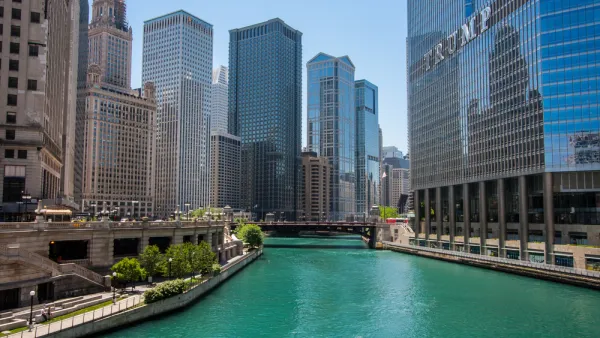
Trump's Controversial Sign of the Times in Chicago
The most conspicuous example of Chicago's recent spat of troubling signage is a 2,891-square-foot sign 200 feet above street level on the Trump International Hotel and Tower in Chicago.
Trump Would Move Infamous Sign From Chicago to the White House If Elected
Republican frontrunner Donald Trump has announced his plan to expand his branding if elected President of the United States in November.
Another Chicago Skyscraper Sign Controversy
Regulations crafted in the wake of the Trump sign controversy of 2014 could be relaxed to let Salesforce leave its mark on the city of Chicago's skyline.

Planetizen Federal Action Tracker
A weekly monitor of how Trump’s orders and actions are impacting planners and planning in America.

California plans to bury El Niño’s downpour
If the state plays its cards right, it may be able to store a billion acre-feet of El Niño’s water in aquifers.

Chicago breaks ground on $3 billion megadevelopment
The new neighborhood, titled Foundry Park, will one day host 3,700 residences.

California High-Speed Rail Authority CEO resigns after $600,000 scandal
Under Ian Choudri, the authority used taxpayer dollars to fund first class flights and trips to nightclubs.

Want to study the Missouri River? Soon, you may need unanimous approval from 10 states
Legislation would require 10 governors’ permission to study or build projects moving water outside the basin.

Desperate measures: Advocates weigh draining Lake Powell to fill Colorado River
Draining the reservoir could reduce evaporation losses by a couple hundred thousand acre-feet.

FREE Course: Walkable City 1: Why Walkability?
After describing his path towards focusing on walkability as the essence of good planning, Jeff Speck marches through his five principal reasons for making more walkable places.
Reinventing Malls: Planning Alchemy—Turning Gray Fields Into Gold
The course focuses on the opportunities and imperatives that shape reinvention of mall sites.

City of Rosemead
Rutgers University, Edward J. Bloustein School of Planning and Public Policy
One Hundred Miles
Hunter College, City University of New York (CUNY)
The Architects Foundation
University of Cincinnati Online
City of Cambridge
Montrose County
The Pocatello Development Authority