Tech firms have taken over more than three million square feet of existing office and industrial space in San Francisco—nearly the equivalent of New York City's new 1 World Trade Center building.


"It has gone widely unremarked, maybe because it’s so obvious to people here, that tech firms in San Francisco have not (yet) been moving into new buildings; they’ve been taking over old ones," writes Michael Kimmelman of the tendency of tech companies in San Francisco to practice adaptive reuse.
"So much media attention has focused on the multibillion-dollar suburban campuses by celebrity designers in Silicon Valley, among them Norman Foster’s doughnut-shaped headquarters for Apple, that adaptive reuse has pretty much slipped under the radar."
For instance, "Twitter has leased a onetime furniture mart on Market Street, and AirBnB has renovated a century-old industrial warehouse south of Market. Yelp occupies part of 140 New Montgomery downtown, the magnificent Art Deco former Pacific Telephone tower from the 1920s, lovingly revamped by Cathy Simon, an architect with Perkins & Will, and the developers Wilson Meany Sullivan."
Kimmelman goes on to detail some specific instances of NIMBY opposition that necessitates, in some cases, adaptive reuse as an architectural stopgap.
Read the full story: Urban Renewal, No Bulldozer

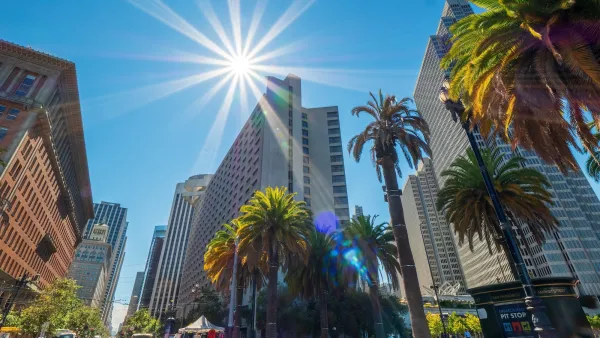
Office conversion is picking up steam in San Francisco
The city spent five years streamlining approval processes and reducing fees to encourage more adaptive reuse of vacant office buildings.
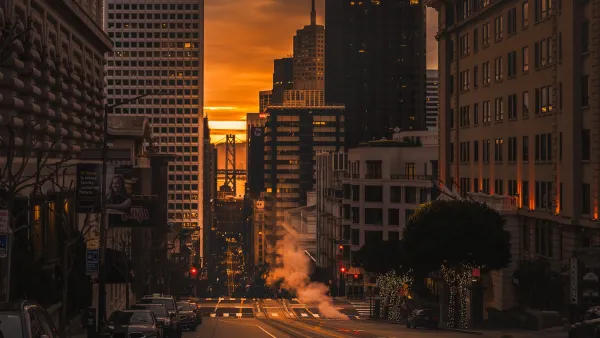
With Zero Office Conversions in Four Years, San Francisco Pins Hopes on New Special Financing District
City leaders hope the new incentive will spur the redevelopment of some of the city’s 30,000 square feet of vacant office space into housing.
Top 5 US Cities for Office-to-Residential Conversions
As more and more cities look to adapt vacant office buildings into homes, a new analysis from Urban Institute says some cities will benefit more than others.

Planetizen Federal Action Tracker
A weekly monitor of how Trump’s orders and actions are impacting planners and planning in America.

Amtrak, CN end decades-long dispute with eight-year agreement
The new operating agreement establishes an updated framework for the companies to work together, including processes to resolve disputes.

Judges permit Denver to divert 77,000 acre feet from the Colorado River for reservoir expansion
Overuse and climate change have caused the Colorado River’s water levels to plummet.

NYC DOT wants faster, more permanent street upgrades
The city is examining ways to build more concrete infrastructure without getting entangled in 'decades-long' projects.

'Something we’ve never seen before:' rising utility rates could strain city finances nationwide
Data centers, climate change and other factors have caused utility rates in the United States to increase by 38% since 2020.

Trump to overrule local leaders, lease millions of acres of America’s Pacific Island territories’ seafloors to mining companies
International law says that the Indigenous people of America’s territories have a right to prior and informed consent regarding projects that impact their countries.

FREE Course: Walkable City 1: Why Walkability?
After describing his path towards focusing on walkability as the essence of good planning, Jeff Speck marches through his five principal reasons for making more walkable places.
Reinventing Malls: Planning Alchemy—Turning Gray Fields Into Gold
The course focuses on the opportunities and imperatives that shape reinvention of mall sites.

Harvard University Graduate School of Design
KFH Group Inc.
Greater Baltimore Committee
The Architects Foundation
University of Cincinnati Online
The Pocatello Development Authority
The Urban Renewal Agency of the City of Pocatello