Convincing neighborhood stakeholders and local businesses that shutting down a street to cars is a good idea can be a herculean task. After nine years of work to do just that, a group of advocates in Philadelphia has lessons to share.


Geoff Kees Thompson reports findings from the "more than 9 years of planning, overcoming opposition and gaining approval," it took to deliver Philadelphia's newest pedestrian plaza: the Triangle at 23rd, South and Grays Ferry Avenue. According to Thompson, it's "the first plaza in Center City that has fully repurposed the street by closing it to vehicular traffic," but the Center City has many more opportunities for similar projects.
Thompson goes on to provide a detailed how-to of how the South of South Neighborhood Association built support among local businesses, maintained the space before the conversion, gathered financial support, pursued political support, and marshaled volunteer labor.
Read the full story: Philadelphia's Newest pedestrian Plaza at the Grays Ferry Triangles: How It Happened, How Much It Cost, Your Playbook

Collaboration Breeds New Capabilities in Philadelphia
Alex Vuocolo reports on the new model of multi-stakeholder collaboration that is bringing acclaimed public spaces, and economic growth, to the city of Philadelphia.
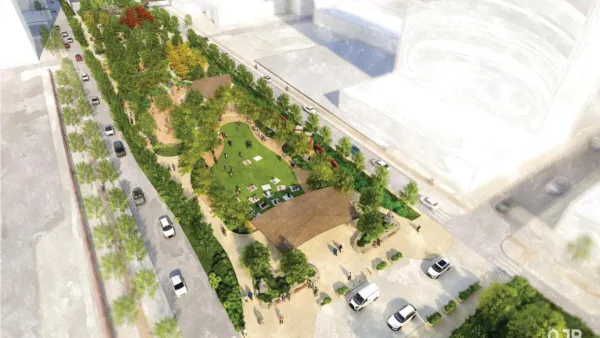
Philadelphia lawmakers fight to save 'Chinatown Stitch' from Trump cuts
The freeway cap project, approved and funded under the Biden administration, is now in jeopardy after the federal government rescinded all but $8 million in funding.
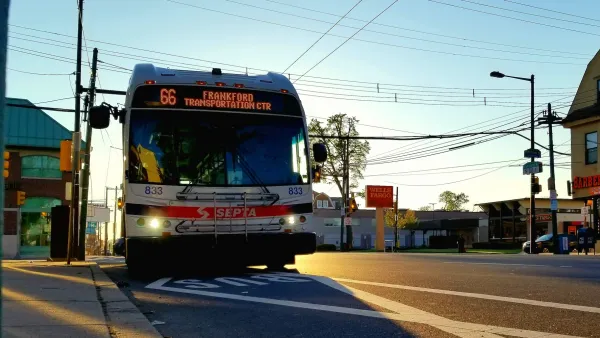
SEPTA's bus-mounted lane enforcement cameras cut travel times by up to 6%
The AI-assisted cameras have issued nearly 200,000 citations to drivers blocking bus lanes.

Planetizen Federal Action Tracker
A weekly monitor of how Trump’s orders and actions are impacting planners and planning in America.

Amtrak, CN end decades-long dispute with eight-year agreement
The new operating agreement establishes an updated framework for the companies to work together, including processes to resolve disputes.

Judges permit Denver to divert 77,000 acre feet from the Colorado River for reservoir expansion
Overuse and climate change have caused the Colorado River’s water levels to plummet.

Atlanta City Council unanimously backs $3.5 billion Beltline light rail project
The resolution was drafted after Atlanta Mayor Andre Dickens pulled support for the Atlanta Streetcar extension last year.

SEPTA to bring nearby frequent transit to over 1 million new riders as part of decade-long plan
The agency's Accelerate plan will also bring frequent transit to twice the amount of jobs that are currently located near it.

NYC plants over 18,000 trees, the most new foliage in a decade
Many of the trees were planted in communities vulnerable to extreme heat.

FREE Course: Walkable City 1: Why Walkability?
After describing his path towards focusing on walkability as the essence of good planning, Jeff Speck marches through his five principal reasons for making more walkable places.
Reinventing Malls: Planning Alchemy—Turning Gray Fields Into Gold
The course focuses on the opportunities and imperatives that shape reinvention of mall sites.

City of Thousand Oaks
City of Wisconsin Rapids
Harvard University Graduate School of Design
The Architects Foundation
University of Cincinnati Online
The Pocatello Development Authority
The Urban Renewal Agency of the City of Pocatello