Denver's Union Station Bus Terminal opened over the weekend, the latest step in its ongoing transformation into a hub of intermodal activity as well as a bridge between the contemporary and the historic.


Cathy Proctor reports on the opening of the Union Station Bus Terminal in Denver. The bus terminal is part of a $480 million project to transform the historic Union Station into a intermodal hub at the center of the city's new FasTrack light rail system.
"FasTracks calls for more than 120 miles of rail to be built throughout Denver, with the first line from Golden completed in 2013. A rebuilt Union Station lies at the center of the network," reports Cathy Proctor.
Skidmore, Owings, & Merrill LLP (SOM) designed the new concourse as well as a master plan for the surrounding transit oriented neighborhood. Here's how a press release from SOM announcing the opening describes the new terminal's role in the new Union Station: "the firm converted 20 acres of former rail yards into an urban transit district that orchestrates light rail, commuter and intercity rail, bicycle and bus routes, and pedestrian pathways into an intuitive intermodal hub. The Union Station Bus Concourse is situated at the heart of this vibrant network, directly beneath the rail station."
FasTracks calls for more than 120 miles of rail to be built throughout Denver, with the first line from Golden completed in 2013. A rebuilt Union Station lies at the center of the network.
Montey Whaley was on the scene for the terminal's first weekday service: "The 22-gate, underground bus terminal…got its first trial by fire Monday morning when weekday commuters began streaming into the facility for the first time." As for the facility's performance, reviews were positive, and "RTD officials reported few problems with the concourse, which was full of helpful volunteers, RTD security and Denver police."
For pretty pictures, see Geoff Manaugh's post on Gizmodo.
Read the full story: Opening of Denver Union Station's transit center draws hundreds
New Transit Center Coming to Cincinnati's Northside Neighborhood
The Cincinnati City Council this week approved zoning change to allow for the construction of a transit center at the second busiest bus transit hub in the city.
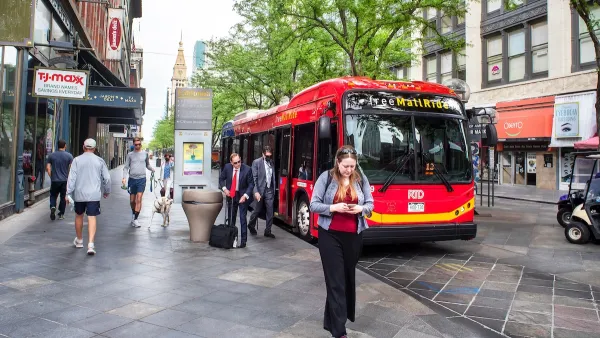
One of Denver’s busiest corridors to gain BRT
The project will span 18 miles and contain 74 bus rapid transit stations.
Learning loss and urban schools, part 2
Did test scores in progressive cities drop more post-COVID than test scores in moderate ones?

Planetizen Federal Action Tracker
A weekly monitor of how Trump’s orders and actions are impacting planners and planning in America.

Eastern Nebraska is running out of electricity
Data centers and electrification are straining eastern Nebraska’s grid, throttling economic development.

Study reveals best places in the U.S. for cycling, walking
New research from Streetlight Data examines bicycle and pedestrian miles per capita in the 100 largest U.S. cities by population.

DSA members accuse Mamdani of 'abandoning values' over housing redevelopment
New York City's mayor plans to replace about 2,000 units of public housing with private, mixed-income housing.

All sides of BRT debate unhappy with CDOT’s most recent move
The Colorado Department of Transportation is no longer considering center-running bus lanes for Colorado Boulevard.

Massachusetts bogs generate both power, and cranberries
Putting solar panels above farmland is one way Massachusetts is advancing toward its goal of net-zero carbon emissions by 2050.

FREE Course: Walkable City 1: Why Walkability?
After describing his path towards focusing on walkability as the essence of good planning, Jeff Speck marches through his five principal reasons for making more walkable places.
Reinventing Malls: Planning Alchemy—Turning Gray Fields Into Gold
The course focuses on the opportunities and imperatives that shape reinvention of mall sites.

City of Rosemead
Rutgers University, Edward J. Bloustein School of Planning and Public Policy
One Hundred Miles
University of Michigan School for Environment and Sustainability (SEAS)
Hunter College, City University of New York (CUNY)
The Architects Foundation
City of Cambridge
The Pocatello Development Authority
The Urban Renewal Agency of the City of Pocatello