The U.S. Department of Agriculture recently released its 2012 Agriculture Census. The census provides data like how much wheat the state of Kansas produced and the average age of U.S. farm operators.


Brett Walton shares the news of the recent release of a mountain of data from the 2012 Census of Agriculture. "Every five years, the U.S. Department of Agriculture takes on the Herculean task of assessing the state of the American farm economy," writes Walton; "[the] numbers cover a stunningly broad territory, from fine-grained county assessments of production and expenses to national summaries of farms and their owners."
A few things Walton noticed from his initial study of the data:
- "Nebraska keeps its title as irrigation champion. Nebraska irrigates 8.3 million acres of land, topping California, the runner up, with 7.9 million."
- "Irrigation is moving eastward. No longer the domain of the dry west, irrigation is establishing a pivot-hold in the Corn Belt and the Midwest and is becoming dominant in the Mississippi Delta."
See the related links, found below, for a small sample of local coverage of the census findings.
Read the full story: Census of Agriculture Data Is Christmas for Farm Nerds

Water Woes Hurting California's Farming Towns
California's Central Valley is one of the top agricultural sites in the world, but with low rainfall and cut-off irrigation supplies, farming towns and their citizens may face at least one tough year ahead.

Arizona Native Community Launches First Solar-Over-Canal Project
Covering an irrigation canal with solar panels doubles its utility, producing renewable energy while protecting canal infrastructure and reducing water evaporation.
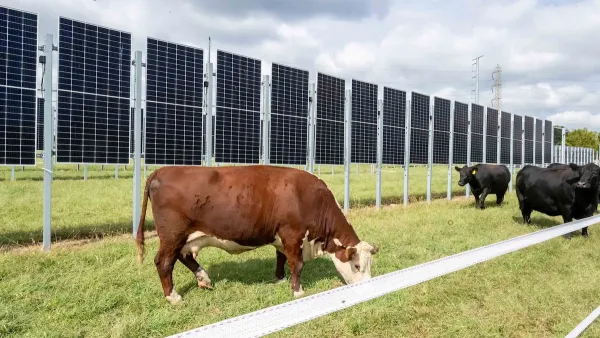
New Jersey Agrivoltaic Project Combines Solar Energy With Farming
A Rutgers University-New Brunswick demonstration farm will evaluate solar array designs to understand how they can best support grazing and agriculture on the same site.

Planetizen Federal Action Tracker
A weekly monitor of how Trump’s orders and actions are impacting planners and planning in America.

California plans to bury El Niño’s downpour
If the state plays its cards right, it may be able to store a billion acre-feet of El Niño’s water in aquifers.

Chicago breaks ground on $3 billion megadevelopment
The new neighborhood, titled Foundry Park, will one day host 3,700 residences.

California High-Speed Rail Authority CEO resigns after $600,000 scandal
Under Ian Choudri, the authority used taxpayer dollars to fund first class flights and trips to nightclubs.

Want to study the Missouri River? Soon, you may need unanimous approval from 10 states
Legislation would require 10 governors’ permission to study or build projects moving water outside the basin.

Desperate measures: Advocates weigh draining Lake Powell to fill Colorado River
Draining the reservoir could reduce evaporation losses by a couple hundred thousand acre-feet.

FREE Course: Walkable City 1: Why Walkability?
After describing his path towards focusing on walkability as the essence of good planning, Jeff Speck marches through his five principal reasons for making more walkable places.
Reinventing Malls: Planning Alchemy—Turning Gray Fields Into Gold
The course focuses on the opportunities and imperatives that shape reinvention of mall sites.

City of Rosemead
Rutgers University, Edward J. Bloustein School of Planning and Public Policy
One Hundred Miles
Hunter College, City University of New York (CUNY)
The Architects Foundation
University of Cincinnati Online
City of Cambridge
Montrose County
The Pocatello Development Authority