A recent opinion article by Richey Piiparinen of the Center for Population Dynamics at the Levin College of Urban Affairs at Cleveland State University says “Cleveland's negativity is a challenge to the city's future.”


In reacting to the recent launch of the “Positively Cleveland” campaign, Richey Piiparinen finds fault in the "nattering nabobs of negativism" he believes to be holding back the city.
In starting a new era for the city, Piiparinen agues that “what's missing from the equation is that deciding on whether or not to invest in Cleveland is made through a perceptual lens. After all, cities are like stocks, and whether or not Cleveland is a ‘bull’ or ‘bear’ market depends partly on the vibe given off.”
The article provoked critics on Twitter, such as Angie Schmitt, who pointed to a recent study finding that 53.9 percent of children in Cleveland live in poverty. Schmitt's thoughts on the power of positive thinking:

So what do you think? Where does the time for positive reinforcement end and the time for sober assessment begin, or vice versa?
Read the full story: The remake by the lake: Richey Piiparinen
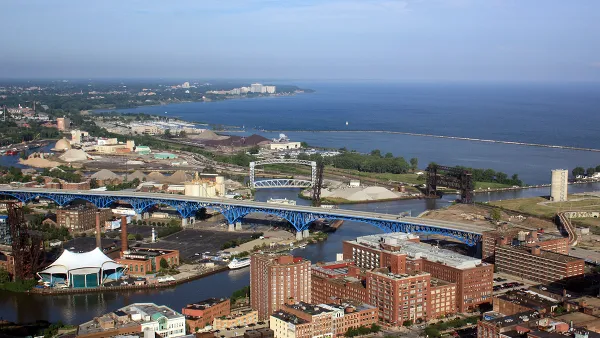
‘This is Cleveland’ Rebranding Appeals to Millennials, Hipsters
Positively Cleveland, Northeast Ohio’s tourism bureau, has launched a new campaign, “This is Cleveland,” that takes a new tack in selling the region not for its orchestra and the Rock and Roll Hall of Fame, but rather for its warts and all.
A Look at the Country's Worst Municipal Branding Campaigns
Grist has asked its readers to help it compile some of the country's "most craptastic urban rebranding efforts ever." And boy have they delivered.
On the Ethos of City Branding: Or, Trying versus Being
As Cleveland takes on yet another effort in "rebranding", Richey Piiparinen looks at past schemes and finds it's better to keep it real.

Washington state to charge fee to drivers with fuel-efficient cars
Revenue from the fee will go towards supporting the state’s highways.

Illinois considers spending $1 billion in taxpayer money on data center
A quantum computing campus and data center are currently under construction in Chicago.

Trump to blast ‘hydrocarbon highway’ through ‘world’s longest art gallery’
Environmental and historic preservation groups are suing to stop the project.

NYC, state sue feds over mixed-immigration-status housing assistance rule
The state’s lawsuit argues that the rule change violates the Administrative Procedure Act.

Michigan to turn neighborhood into virtual power plant
Residents will soon be able to divert their excess energy to the grid in exchange for compensation.

Data center, mining project swarm to long-awaited Alaska railroad line
The state-owned railroad approved final plans for the spur line this week; the project is expected to cost $311 million, mostly funded by the federal government

FREE Course: Walkable City 1: Why Walkability?
After describing his path towards focusing on walkability as the essence of good planning, Jeff Speck marches through his five principal reasons for making more walkable places.
Reinventing Malls: Planning Alchemy—Turning Gray Fields Into Gold
The course focuses on the opportunities and imperatives that shape reinvention of mall sites.

City of Charlotte
City of Rosemead
Rutgers University, Edward J. Bloustein School of Planning and Public Policy
University of Michigan School for Environment and Sustainability (SEAS)
Hunter College, City University of New York (CUNY)
The Architects Foundation
University District Partnership