A new web-based program, Global Forest Watch, provides access to almost real-time visualization of forests around the world.


Jared Green reports on a web-based tool, Global Forest Watch that “aims to provide a “near-real time” view of deforestation (and reforestation) around the world.” The program, which is provided by World Resources Institute, allows unprecedented visualization of deforestation: “As Rebecca Moore, engineering manager with Google Earth, explained to Reuters: 'With the exception of Brazil, none of the tropical forest countries have been able to report the state of their forests. Now it will be possible to have near real-time updates of the state of the world’s forests, open to anyone to use.'”
The web tool “uses more than half a billion high-res images from NASA’s Landsat program, which are organized with new algorithms created by the University of Maryland, and then made available for easy online access thanks to the cloud computing power of Google’s Earth and Maps engines.” Users and watch groups can collect information as well as “submit data, pictures, and video on the ground.”
The benefits of this crowdsourcing ability is a “near real-time” monitoring of existing tree cover anywhere in the world. “BBC News writes that high-res images of global tree loss and gain are updated annually while data on tropical forests is updated monthly.”
Read the full story: Tracking Global Deforestation (and Reforestation)

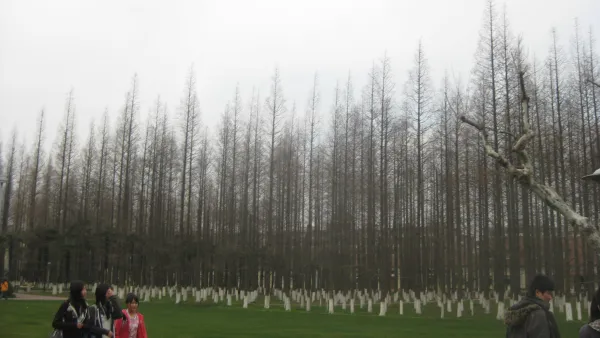
China Plants 'Great Green Wall' of Trees
Net deforestation continues, but at a slower rate as the world's largest ecological engineering project stretches for a planned 2,800 miles. It is hoped the new trees will halt the advance of the Gobi Desert.
How to Prevent National Forests Becoming 'National Ashtrays'
An editorial calls for innovative policy in post-fire recovery and reforestation. The recent release of the Environmental Impact Statement for the recovery of the Rim Fire should serve as a barometer for a "new public forestry."
From Academia to Action: An Indigenous Reforestation Effort in Los Angeles
Ary Amaya, a UCLA graduate student, leads an Indigenous-led reforestation effort in Los Angeles, integrating cultural practices and ecological restoration across 27 acres to promote Indigenous sovereignty and sustainable land management.

Planetizen Federal Action Tracker
A weekly monitor of how Trump’s orders and actions are impacting planners and planning in America.

California plans to bury El Niño’s downpour
If the state plays its cards right, it may be able to store a billion acre-feet of El Niño’s water in aquifers.

Chicago breaks ground on $3 billion megadevelopment
The new neighborhood, titled Foundry Park, will one day host 3,700 residences.

California High-Speed Rail Authority CEO resigns after $600,000 scandal
Under Ian Choudri, the authority used taxpayer dollars to fund first class flights and trips to nightclubs.

Want to study the Missouri River? Soon, you may need unanimous approval from 10 states
Legislation would require 10 governors’ permission to study or build projects moving water outside the basin.

Desperate measures: Advocates weigh draining Lake Powell to fill Colorado River
Draining the reservoir could reduce evaporation losses by a couple hundred thousand acre-feet.

FREE Course: Walkable City 1: Why Walkability?
After describing his path towards focusing on walkability as the essence of good planning, Jeff Speck marches through his five principal reasons for making more walkable places.
Reinventing Malls: Planning Alchemy—Turning Gray Fields Into Gold
The course focuses on the opportunities and imperatives that shape reinvention of mall sites.

City of Rosemead
Rutgers University, Edward J. Bloustein School of Planning and Public Policy
One Hundred Miles
Hunter College, City University of New York (CUNY)
The Architects Foundation
University of Cincinnati Online
City of Cambridge
Montrose County
The Pocatello Development Authority